Research
One’s trash is another’s treasure: European circularity moves from ambition to regulation

The EU is moving from circular-economy ambition toward binding market rules. The planned Circular Economy Act could create demand for secondary raw materials through recycled-content requirements and a more harmonized single market, but its effects will vary across materials and the waste value chain. Whether it strengthens European recycling will depend on the obligations and timelines it sets.

Summary
Circularity becomes an EU industrial priority
EU waste policy has traditionally been driven by environmental and public health concerns, with a focus on safe treatment and pollution reduction. That is now changing. Waste policy is increasingly framed as a strategic economic and industrial priority, part of a broader circular economy agenda rather than a waste-focused one.
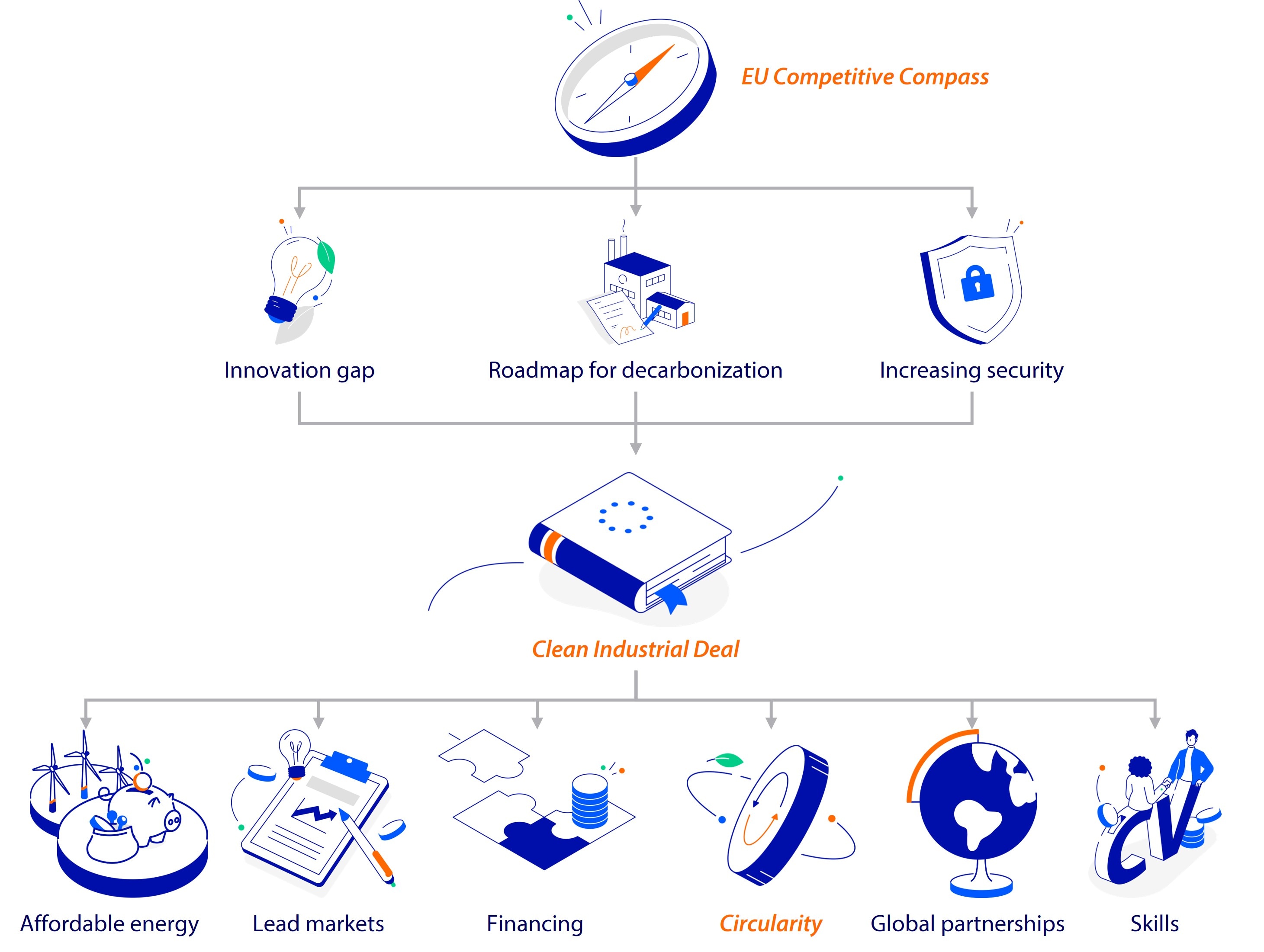
This shift became explicit in 2024, when reports by Mario Draghi on European competitiveness and Enrico Letta on the single market both identified the circular economy as a critical lever for reducing raw material dependency and lowering input costs for energy-intensive industries. The Commission translated these findings into policy. Circularity sits under the Clean Industrial Deal as a central element within industrial strategy, aligned with the Competitiveness Compass introduced in early 2025.
As our first article on circularity explained, however, Europe’s waste management system was built primarily to collect and treat waste, not to supply manufacturers with specification-grade secondary raw materials. For waste management, this repositions the sector from a downstream environmental service to a supplier of secondary raw materials. The commercial significance lies in what the sector sells. A waste manager paid to remove material earns a gate fee and is relatively insulated from commodity prices. A supplier of secondary raw materials earns a market price and faces different margins, risks, and capital requirements.
Figure 1: Circularity moves to the center of EU industrial strategy
The EU’s ambition outpaced market development
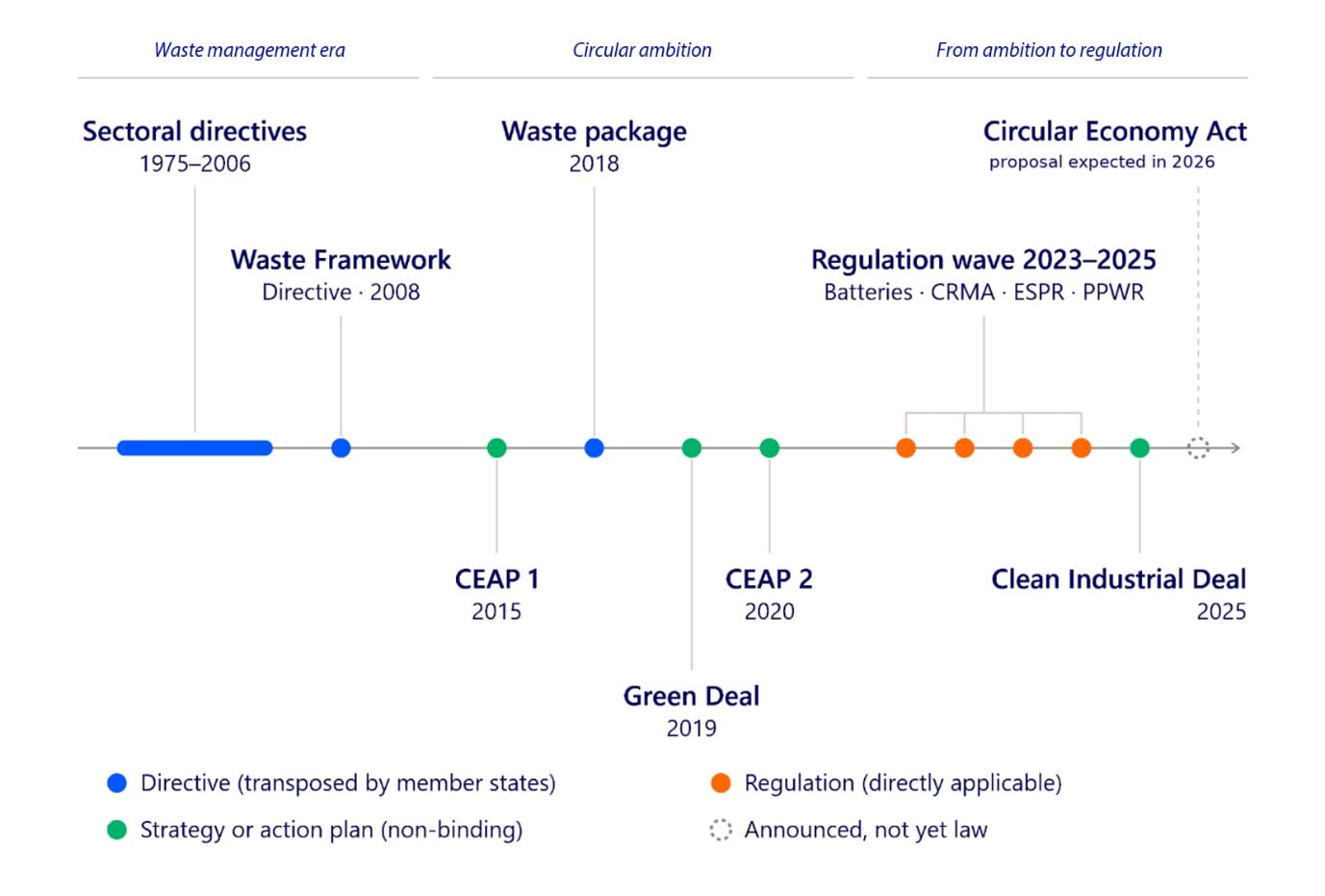
EU waste and circular-economy policy rests on the Waste Framework Directive, first adopted in 2008. It establishes the waste hierarchy and the broader framework for waste prevention, collection, and treatment. Its legal form matters: because a directive must be transposed into national law, the framework has resulted in 27 national systems with differences in waste classification, end-of-waste decisions, and producer-responsibility arrangements.
What followed was ambition rather than market obligation. The Circular Economy Action Plans of 2015 and 2020 extended the agenda beyond waste treatment toward material use, product design, and reuse, but they did not create the kind of directly binding product and market obligations now emerging. Those arrived later through regulations such as the Batteries Regulation, the Critical Raw Materials Act (CRMA), the Ecodesign for Sustainable Products Regulation (ESPR), and the Packaging and Packaging Waste Regulation (PPWR). The Waste Shipment Regulation is not shown separately in the figure below but is still relevant because it governs cross-border waste flows and export controls. Unlike directives, regulations apply directly in every Member State.[1]
[1] An explanation of the different types of EU regulation: Types of legislation | European Union
Figure 2: EU circular-economy ambition has advanced faster than market obligation
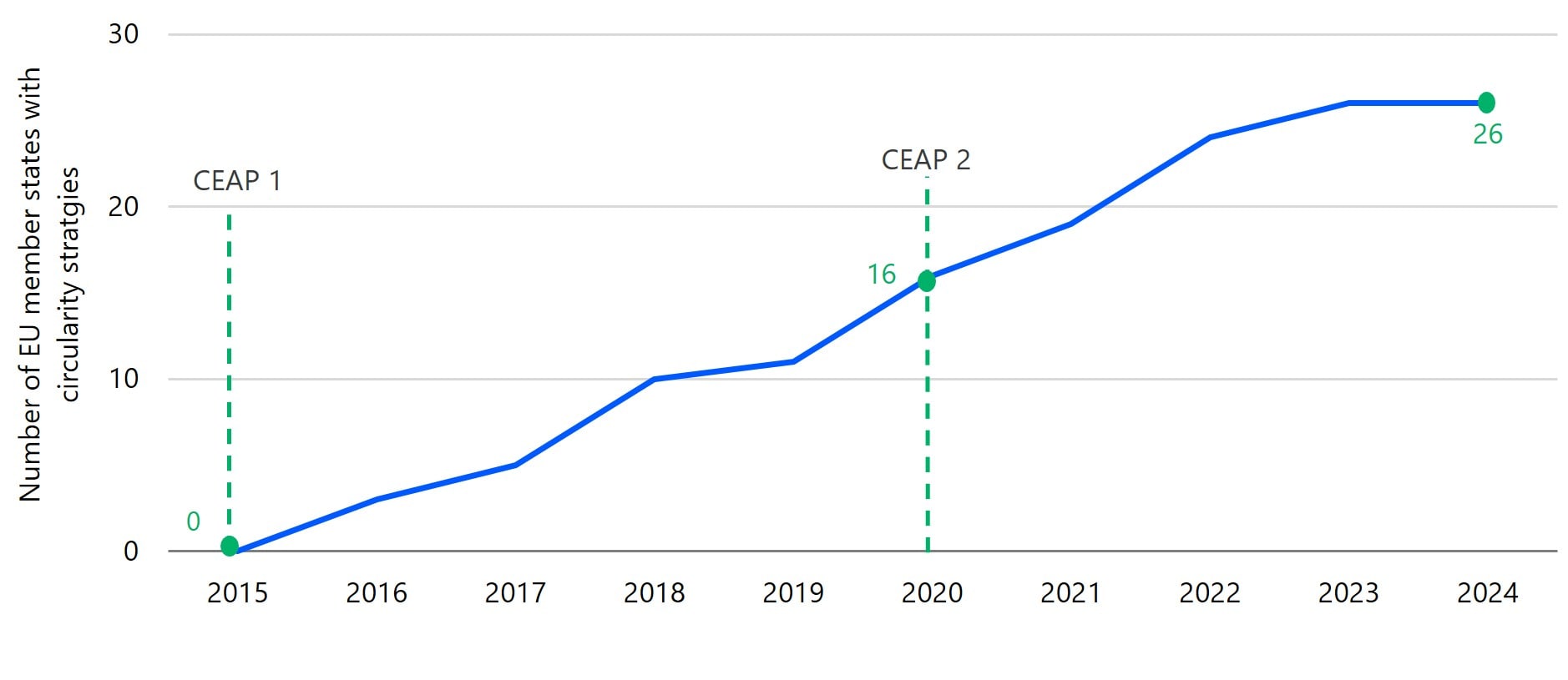
Member states followed the same pattern. At the beginning of 2015, no EU member state had a dedicated circular economy strategy. By 2024, 26 did, as figure 3 shows. The absence of national strategies was no longer the main constraint.
Figure 3: EU member states with circular-economy strategies rose from zero to 26 between 2015 and 2024
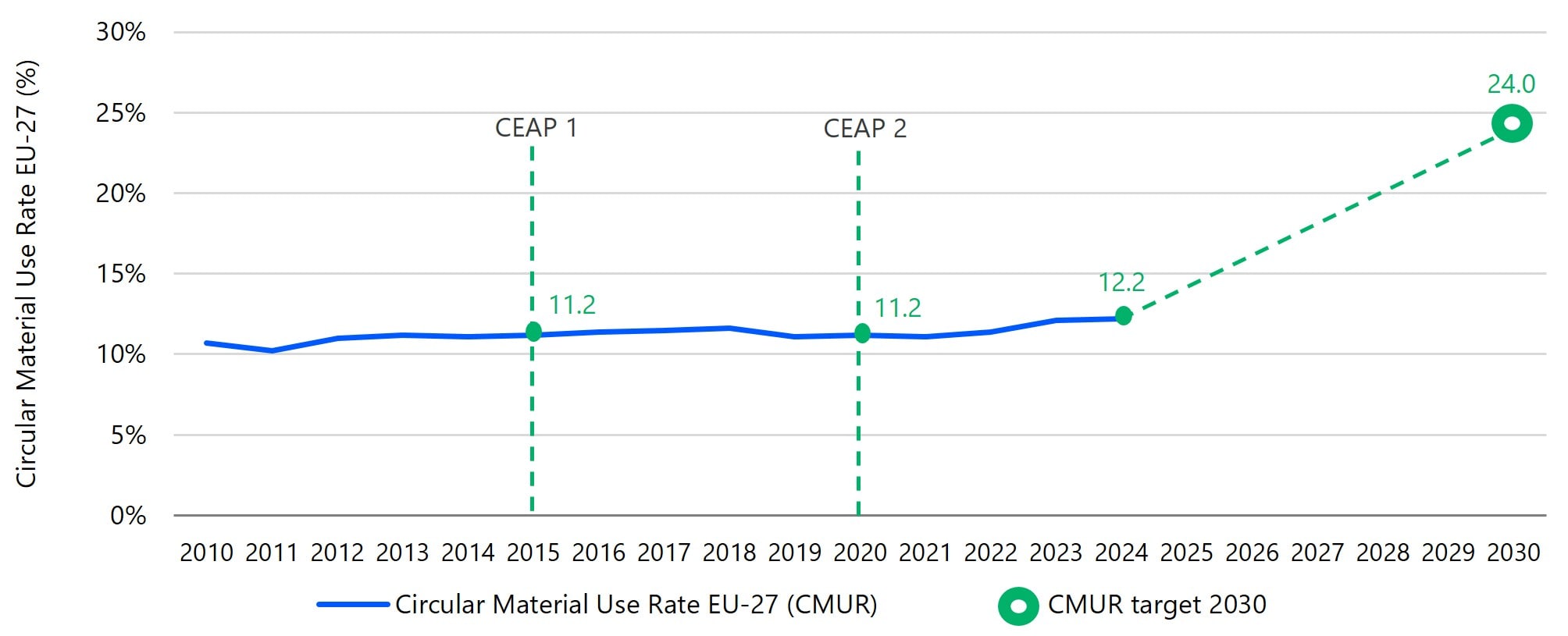
The outcome remains modest. Figure 4 tracks the circular material use rate, which moved from 11.2% in 2015 to 12.2% in 2024, against a 2030 target of 24%. Reaching that target would require far faster progress than the previous decade delivered. Material is still leaving the economy at scale.
Figure 4: EU circular material use has barely increased despite rising policy ambition
That is not the same as policy failure. Recycling rates improved in several streams, and directly applicable product regulation is still too recent to show fully in the data. Part of the gap is structural: material remains locked in buildings, infrastructure, and vehicles for years before it can return as secondary supply. But policy design also matters. The European Court of Auditors reached a similar verdict in 2023, concluding that progress has fallen short of what the framework was designed to deliver. The ambition and the strategies are in place. The market obligations are only now arriving.
The Circular Economy Act: Building the missing market infrastructure
The Circular Economy Act (CEA) is expected to broaden the shift from policy ambition to direct market obligations. The Commission plans to present its proposal in the third quarter of 2026.
Discussion among EU institutions, member states, industry, and civil-society organizations increasingly focuses on the conditions needed for secondary-material markets to function. These include product design that limits recovery before waste is collected, revenue models that reward handling volume more consistently than material quality, and uneven end-market demand for secondary raw materials. The CEA debate adds a fourth constraint: market fragmentation. End-of-waste (EoW) criteria determine when recovered material ceases to be legally classified as waste and can instead be traded as a product. Extended Producer Responsibility (EPR) rules determine how producers finance and organize the collection and treatment of their products at end of life. Because these rules – like waste classifications – remain different across member states, secondary materials cannot move freely enough and circular markets struggle to reach competitive scale.
Table 1 groups the main instruments under discussion by the constraint instrument would address, drawing on Commission material, parliamentary analysis, and stakeholder positions. Two could have the greatest direct effect on demand: recycled-content requirements, which would require manufacturers to use a minimum share of recycled material, and circular public procurement, which would use public purchasing to create demand for recycled and reusable goods at scale.
Table 1: Emerging Circular Economy Act measures and the constraints they aim to address
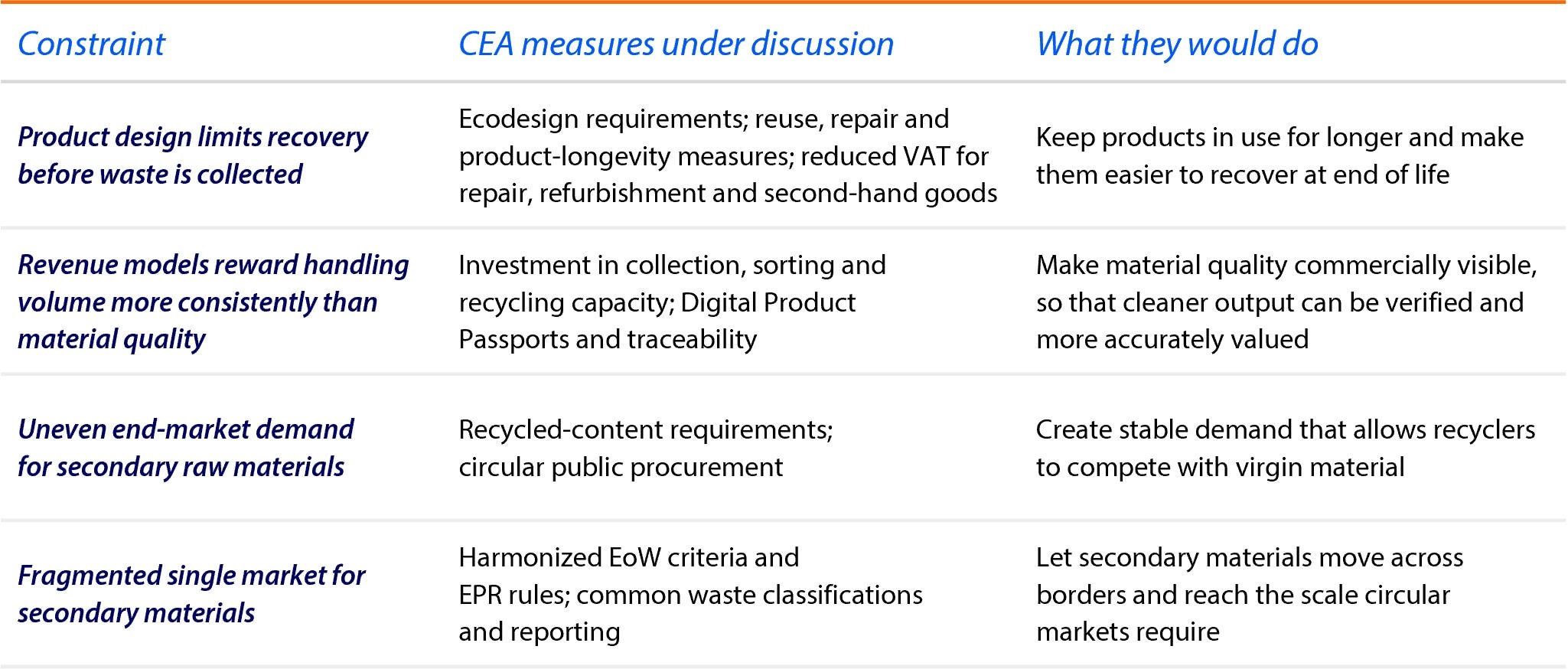
For many secondary materials, the missing link is reliable demand. Better design, collection, and sorting have limited commercial value if manufacturers do not use the recovered material. Earlier rules focused mainly on increasing collection and recycling and placed most obligations on member states. The measures under discussion for the CEA would reach companies more directly. Where recycled-content requirements are established as product conditions, non-compliance could prevent a manufacturer from placing the relevant product on the EU market.
Demand mandates such as recycled-content rules and public procurement matter most where voluntary markets are weak. EoW criteria aligned across member states would allow recovered material to be traded as a product across borders rather than remaining subject to different national waste regimes. Digital Product Passports provide information on composition and other characteristics relevant to repair, sorting, and recycling, while traceability helps buyers verify the origin and characteristics of secondary materials. Together, these measures connect demand with material that buyers can identify, verify, and use.
The European Environment Agency reached a similar conclusion in April 2026. It found that high collection rates had not translated into sufficient uptake of secondary raw materials, partly because virgin materials were often cheaper, and argued that stronger market structures were needed to stimulate demand for recycled content.
The CEA would extend an existing policy model
Elements of this approach already exist in specific product groups. The Batteries Regulation goes furthest, combining recycled-content requirements, recovery targets, and a digital product passport in one instrument. It provides the closest existing example of the model the CEA could apply more broadly. The PPWR and CRMA follow the same direction in their respective sectors. All three regulations – Batteries, PPWA and CRMA – apply directly in every member state.
What the CEA would add is breadth: a similar approach across more materials, supported by the rules and systems needed to meet recycled-content requirements in practice. A percentage obligation is only as useful as the supply of qualifying material manufacturers can actually buy.
Whether the CEA delivers that breadth will depend on the final proposal. The Commission has also committed to regulatory simplification, and several measures under discussion would add obligations rather than remove them. A proposal that sets targets without credible enforcement, or leaves percentages and dates to later decisions, would leave much of the current situation intact.
Timing matters as well. Existing rules on batteries, packaging, and product design are already having some effects, but the CEA will take longer. The proposal must first be negotiated and adopted, after which companies are likely to receive time to comply. Adoption is therefore unlikely before 2028, with many obligations taking effect around 2029 or 2030. The main commercial effects may still be several years away, but companies making long-term investments today will need to prepare for them.
The impact falls unevenly along the chain
The waste management value chain runs from collection through sorting and processing to material recovery, with energy recovery and landfill as the fallbacks. This section uses the same chain as an impact map. Instead of asking what happens to the material, it asks what the measures under discussion would change for the companies active at each stage. The test is the same throughout: Would the measure impact the volume handled, the price achievable, or the certainty of demand? In practice, that could mean more material entering a facility, a higher price for specification-grade output, a longer-term offtake agreement, or new investment in sorting and quality control. Those effects determine whether regulation changes a company’s revenue, raises its investment needs or remains mainly a compliance issue.
Collection changes least because much of the regulatory framework already exists
Separate collection obligations already apply to several key waste streams under EU legislation.[2] The CEA is therefore unlikely to change collection as much as later stages of the value chain. Volumes could increase modestly where enforcement improves or separate collection expands but recycled-content requirements mainly create demand for recycled material – recyclate – rather than for collection itself. They may not significantly increase the value of collected waste either, since much of that value is created later through sorting, processing, and end-market demand. Collection remains essential, but the CEA’s main commercial effects are likely to occur further down the chain.
Sorting shifts the emphasis from volume to quality
Sorting separates mixed waste into cleaner fractions, and the quality of those fractions sets a ceiling on the recyclate that processing later can produce. For sorting operators, the CEA is therefore likely to change the value of output more than the volume handled. Consistent, high-quality material could attract stronger demand and command a better price, while mixed or low-grade output may remain difficult to sell. A plastics sorter, for example, may need additional optical sorting, washing, or quality-control equipment to separate material by polymer, color, and contamination level. That investment only pays if the cleaner output attracts a higher price or a more reliable buyer.
Processing stands to gain the most from stronger demand for quality output
Recyclers compete with virgin materials priced in global commodity markets, often without a guaranteed buyer. Binding recycled-content requirements and circular public procurement could turn part of that uncertain demand into required demand. A plastics recycler that currently sells output on short-term contracts, for example, could secure a longer-term agreement with a packaging manufacturer that needs qualifying recyclate to meet a content requirement. More reliable offtake and potentially better prices could, in turn, support capacity expansion or investment in higher-quality processing. The benefit depends on the levels and dates set: requirements at or below current recycled-content use would create little additional demand. Prevention, reuse, and repair pull in the opposite direction by reducing the material entering the waste chain. Over time, total processing volumes could therefore fall even as prices and demand certainty improve for material recovered to a high specification.
Material use shifts responsibility toward manufacturers
The loop closes only when manufacturers and industrial buyers use secondary raw materials in place of virgin materials. Recycled-content requirements would make part of that demand mandatory. Manufacturers would need to buy more qualifying recyclate, increasing demand certainty for processors. Where that material is more expensive, less consistent, or harder to source than virgin materials, manufacturers could face higher costs and greater supply-chain complexity. A manufacturer might respond by signing a long-term supply agreement, adapting its product to use recycled material or investing in its own recycling capacity. Manufacturers that secure supply in advance or control part of the recycling process would face less risk than those buying recyclate on the open market as they need it.
Energy recovery and landfill face uncertainty over residual volumes
Every ton of waste prevented, prepared for reuse, or recovered as material reduces the volume potentially available for incineration or landfill. The CEA would therefore affect energy recovery and landfill mainly indirectly: Measures that move material higher up the waste hierarchy leave less residual waste for these routes.
For waste-to-energy and landfill operators, the main pressure comes from uncertainty over future waste volumes. Waste-to-energy plants have high fixed costs and are built to operate for decades, often on the assumption that they will receive a minimum amount of waste each year. Economic growth could increase total waste generation, partly offsetting higher reuse and recycling. But if material is diverted from residual waste faster than total waste grows, a plant may receive less waste, operate below capacity, and earn less in gate fees. The impact will depend on local treatment capacity and contracts. Electricity and heat sales provide additional revenue, especially where plants supply district heating, but they do not remove this feedstock risk. Landfills face the same pressure, with fewer alternative sources of revenue.
Carbon pricing could add a separate pressure. Municipal waste incinerators above 20 MW have monitored and reported emissions under the EU Emission Trading System (ETS) since 2024 without having to surrender allowances. In July 2026, the Commission proposed extending the EU ETS to non-hazardous waste incineration and co-incineration from 2031, with allowance obligations phased in through 2034. If adopted, some incineration plants could face declining waste volumes and additional carbon costs at the same time.
[2] EU legislation requires separate collection for several waste streams, although the scope, implementation, and performance of collection systems remain uneven across member states.
How policy impact varies across material streams
The same measure can transform one material market while having little effect on another. Recycled-content requirements provide the clearest example: They can reshape markets where buyers are scarce and quality is uneven, but matter less where recovered material is already collected, traded, and priced as a commodity. Other measures – including design rules, traceability, and EoW criteria – also have different effects depending on the material. Box 1 shows this contrast through plastics and steel and aluminum.
Box 1: The same chain, two materials
Plastics: Recycled-content requirements create demand, but only for material that meets buyer specifications. Meeting those specifications depends on product design, collection, and sorting. If European recyclate does not qualify, manufacturers may turn to imports, while shortages could raise prices or make compliance more difficult. Several measures must therefore work together: design rules, better collection and sorting, recycled-content requirements, traceability, and clearer EoW criteria. Creating demand without improving quality may increase imports rather than strengthen European recycling capacity.
Steel and aluminum: Secondary-metal markets already function with less demand-side regulatory support. Scrap has significant residual value and is collected, priced, and traded as a commodity. Secondary production also uses substantially less energy than primary production, supporting demand on economic as well as compliance grounds. Policy therefore has less need to create demand. Its greater role is to improve scrap quality, retain material within Europe, and reduce barriers to cross-border trade.
The other material streams fall between these two cases, depending on how well their markets already function and which barriers remain. Table 2 assesses how much the CEA could change the volume handled, the price achieved, and the certainty of demand in each market. High means the measures could significantly change a developing or fragmented market. Medium means a market functions but still faces barriers related to quality, regulation, or end use. Low means an established end market already exists, so the CEA is more likely to improve quality, align rules across member states, or retain more material within Europe than to significantly change demand, prices, or investment.
Table 2: Expected policy impact by material stream and market maturity
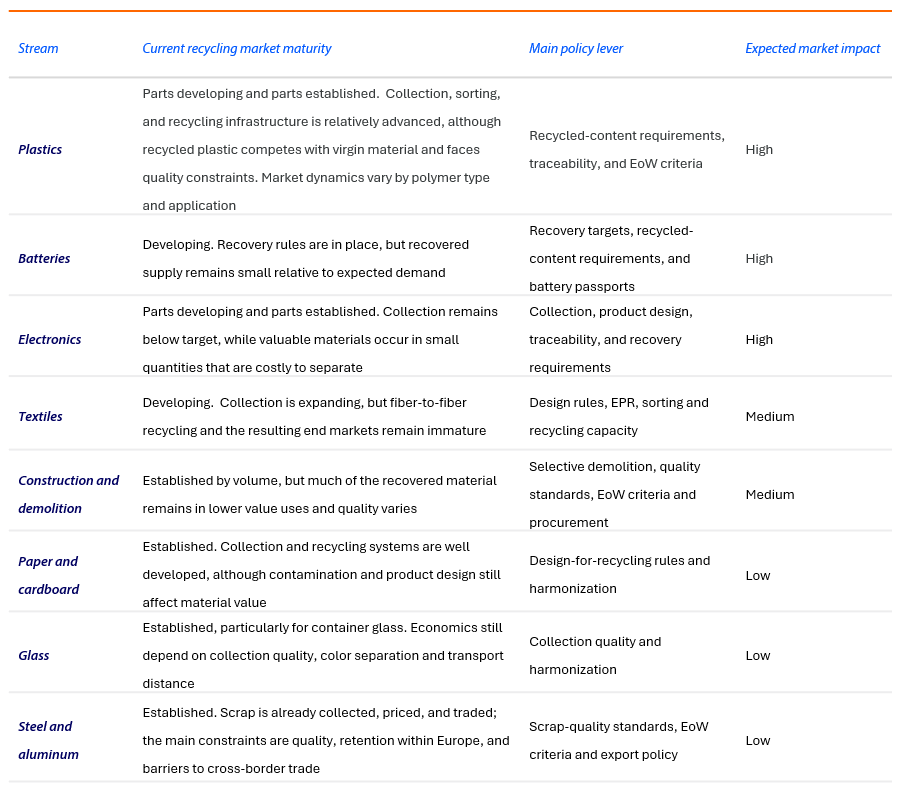
Few operators are active in only one material stream. Most handle several materials across shared assets, so Table 2 provides a portfolio view rather than a rating of individual companies. Operators with greater exposure to plastics, batteries, and electronics may face higher investment needs, but also greater potential gains from the CEA. Those concentrated in established paper, glass, and metals markets are likely to experience a smaller change in market conditions.
One risk applies across the table. Recycled-content requirements would create demand in Europe, but that demand would not necessarily have to be met with European recyclate. Existing rules take different approaches to imports, using conditions such as traceability, comparable environmental standards, and closed-loop requirements. How the CEA treats and verifies imported recyclate, alongside the Waste Shipment Regulation’s role in governing waste exports, may therefore matter almost as much as the percentages it sets. This will determine how much of the additional demand ends up supporting European sorting and recycling capacity, rather than suppliers outside Europe.
Market structure shapes gains, value chain position shapes exposure
Ultimately, gains depend on market structure – which is why plastics and metals recyclers at the same point in the chain face different prospects – and exposure depends on position in the chain. Energy recovery and landfill provide the clearest example. These could receive less residual waste as more material moves up the waste hierarchy, while carbon pricing could add another cost for waste incinerators.
Three questions will determine the scale of the impact: whether the proposal sets binding percentages and dates, whether EoW rules are aligned across the EU, and how imported recycled material counts toward compliance. Together, these choices will determine whether the CEA creates reliable demand that supports investment in European recycling capacity or mainly adds new compliance requirements.
The CEA would therefore not lift the whole waste sector evenly. It could reward companies able to turn waste into specification-grade material, increase sourcing costs and complexity for companies required to use it, and create risks for assets that depend on a steady supply of residual waste. Whoever gains will depend on the market for each material; who is exposed will depend on where they sit in the value chain.