Research
Scale or specialization: Two paths ahead for the EU fruit and vegetable wholesale sector

European companies in the fresh fruit and vegetable wholesale sector face a range of challenges, from highly variable product availability upstream and fierce competition among numerous industry players to ever-larger buyers and a relatively stagnant downstream market. This raises the question: What strategies will enable fruit and vegetable wholesalers to succeed in an increasingly competitive and complex market?

Summary
The EU fruit and vegetable wholesale sector is diverse and fragmented
The European fresh produce wholesale sector is highly fragmented and diverse. It comprises a wide range of companies performing activities from primary production to retail or foodservice sales of fruits and vegetables. The sector includes not only traditional wholesale companies, but also growers selling their own produce, cooperatives, importers, exporters, fruit ripeners, vegetable processors, packers, logistics service providers, and supermarket procurement organizations.
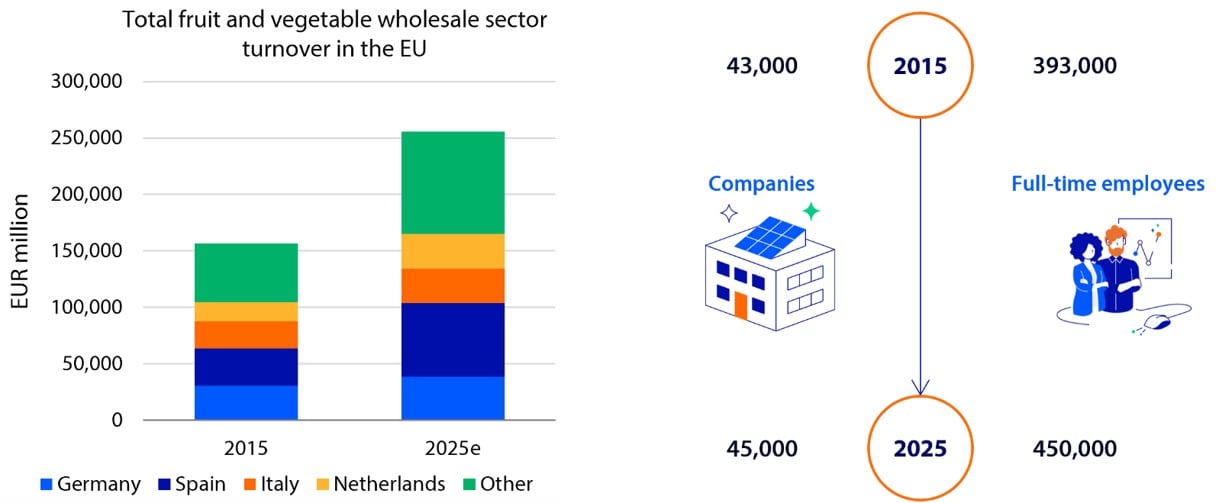
According to Eurostat, nearly 45,000 companies in the EU are active in the wholesale trade of fruit, vegetables, and potatoes, employing around 450,000 full-time employees. Together, these companies generated estimated revenues of around EUR 255 billion in 2025 (see figure 1). The sector’s turnover has increased by an average of 5% per year over the last decade, mainly driven by higher import volumes, inflation, and a shift in consumer preferences toward higher-value fruits. The sector also varies significantly across countries. Spain has the largest fruit and vegetable wholesale sector, reflecting its role as Europe’s largest producer and exporter. Germany ranks second, supported by its large consumer base and strong demand for imports.
While other parts of the value chain – such as production and retail – are consolidating, this trend is less pronounced among wholesalers. The top 10 companies in the EU account for an estimated 12% of the market. The total number of companies grew between 2012 and 2021 but has slowly declined since then, according to Eurostat data.
Figure 1: EU fruit and vegetable wholesale sector size
Imports, integration, and specialization make space for new entrants
The limited consolidation and continued diversity in the sector can be explained by several underlying dynamics, including growing import flows, increasing specialization, and ongoing value chain integration.
Growth in fruit and vegetable turnover has created room for new entrants. In particular, imports of overseas produce have expanded significantly and will likely continue to increase (see figure 2). This growth has been driven by products that have gained popularity in recent years, such as blueberries and avocados. For example, according to Peruvian customs data, the number of EU companies importing blueberries from Peru increased from 30 in 2015 to more than 150 in 2025. These importers include both EU-based companies and sales offices established by exporters from countries such as Peru, Chile, and South Africa.
Chain integration is also increasing and often results in new wholesale players. Examples include growers establishing trading arms and retailers creating their own sourcing organizations instead of relying on intermediaries. Increasingly, retailers do not buy their produce from spot markets but from longer-term partners, either via tenders or longer-term price and volume agreements. Prices and costs have become more transparent. At the same time, more specialized service providers have emerged, offering activities such as ripening, sorting, cold storage, and packaging for a fee. These companies fill gaps for smaller or newer market participants that lack the scale or investment capacity to perform these functions themselves.
Figure 2: EU imports of fresh fruits and vegetables from outside the EU, 2020-2030f

Figure 3: EU production of fruits and vegetables, 2015-2030f

Scale matters, but it’s not the only route to success
Economies of scale play a more limited role in fresh produce wholesale than in primary production or fruit and vegetable processing. Fixed investment requirements are relatively low, and many services, such as ripening, packaging, and transport, can be outsourced. This lowers barriers to entry. In addition, product characteristics limit synergies, as different fruits and vegetables often require specific storage conditions, resulting in separate logistics flows. Variations in cultivation methods, shelf life, and origin further reinforce supply chain fragmentation.
Company size also appears to have a limited impact on profitability. Analysis of more than 10,000 European fruit, vegetable, and potato wholesale companies in Moody’s Orbis database shows an average EBITDA margin of around 3%, primarily influenced by activity type, sales channel, crop, and regional competition, rather than by company size.
Nonetheless, scale can provide advantages. Larger companies can spread technology, certification, and logistics costs over greater volumes and are better equipped to serve customers requiring large and consistent supplies. Scale can also help companies manage risk, for example by diversifying sourcing and sales across products, suppliers, customers, and geographies.
In particular, sourcing risks seem to be rising, both in terms of quantity and quality. EU fruit and vegetable production is declining (see figure 3), while imports are expected to continue growing, albeit with increasing volatility. Climate change, stricter regulations, fewer crop protection options, and growing constraints on water, land, energy, and labor are all contributing to this heightened volatility and may create sourcing and quality challenges for wholesalers and traders. Geopolitical tensions are also disrupting trade and increasing cost volatility.
Slow demand growth and intensifying retail competition is putting pressure on suppliers
At the retail level, competition is intensifying. Margin pressure, stagnant sales volumes, more price-conscious consumers, and a crowded marketplace competing for consumers’ food spending are driving more intense competition and could result in greater pressure on suppliers, including fruit and vegetable suppliers.
Over the last decade, per capita fruit and vegetable consumption has shown little growth, though it increased slightly over the last three years (see figure 4). In the coming years, total consumption volumes are not expected to change much and will likely grow slowly in line with population growth. However, the EU’s population is aging, and population growth is expected to stall from 2030 onward (see figure 5). In large markets such as Germany, Italy, and Poland, population decline has already begun.
Consumers have also become more price-sensitive following recent inflation shocks, including Russia’s invasion of Ukraine in 2022 and the war in Iran in 2026. This has increased competitive pressure among retailers. In addition, new channels such as online retail and meal delivery services are reshaping the market. As a result, supermarkets are forced to invest more in efficiency and/or alternative revenue streams, putting further pressure on their margins and likely on those of suppliers.
Figure 4: Fruit and vegetable consumption in the EU, 2015-2025e

Figure 5: Aging and slowing population growth in the EU, 2015-2030f

Companies will need to choose between scale and specialization to succeed
The fresh fruit and vegetable wholesale sector is not disappearing; it is evolving. In the EU, a more pronounced dual structure is likely to emerge in the coming years. For some companies, there is a strong drive to increase scale and efficiency, reinforced by retailers’ high-volume requirements, intense competition in the retail market, and the need to manage sourcing risks. Risk management capabilities – particularly in sourcing, logistics, and market diversification – will become a more critical success factor. Collaboration across the value chain, including partnerships among growers, traders, and retailers, will become essential to manage volatility and ensure supply resilience.
Alongside this small group of large, consolidated players serving major retailers, there will remain a large group of agile specialists focusing on specific products, markets, or channels. These include Dutch suppliers of fresh herbs for northwestern Europe, French suppliers of premium fruits and vegetables to high-end restaurants, and Italian exporters serving smaller retail chains in Germany, to name a few. The large number of product-market-channel combinations and the diversity of activities across the value chain leave room for companies of different sizes. In addition to reliability and consistency, wholesalers and traders can differentiate themselves through quality, service, and product knowledge.