Research
What the Nordics reveal about the future of Europe’s biomethane

Biomethane is evolving from a renewable gas substitute into a platform for multiple services: emissions reduction, nutrient recycling, carbon management and fuel production. The Nordic experience suggests that future winners will be those who can connect these values to the sectors that need them most.
Summary
Biogases are increasingly seen as strategic energy sources
The role of biogases has expanded well beyond renewable energy production, as we argued in our previous article. The energy crisis following Russia's invasion of Ukraine, and the recent events in the Strait of Hormuz elevated biomethane from a niche decarbonization solution to a strategic energy source, capable of contributing simultaneously to energy security, climate ambitions and rural economic development.
The sector continues to grow across the EU. Investment plans remain strong and new production capacity is being added each year. Yet, the EU is still not on track to achieve the REPowerEU ambition of 35 billion cubic meters (bcm) of biomethane production by 2030. While the technical potential appears sufficient, deployment remains constrained by regulatory complexity, permitting delays, infrastructure bottlenecks, policy uncertainty and market risks of unsubsidized certificate revenues.
This highlights a growing gap between ambition and execution. The next phase of biomethane development will not be determined by technology alone. Instead, competitive advantage is increasingly shaped by market design, centralized governance, certificate systems, carbon pricing and the emergence of industrial demand for low-carbon molecules.
In this context, the Nordic countries present an interesting case. They combine strong climate policies, well-developed waste and circularity systems, abundant biological resources and high levels of institutional support for decarbonization. Yet they have developed quite different markets. While some countries prioritized grid integration and others transport applications, policy support has also varied considerably. As a result, the Nordics offer an early glimpse into how Europe’s biomethane sector may evolve when renewable attributes are valued, traded and monetized alongside the molecule itself.
One region, four different pathways
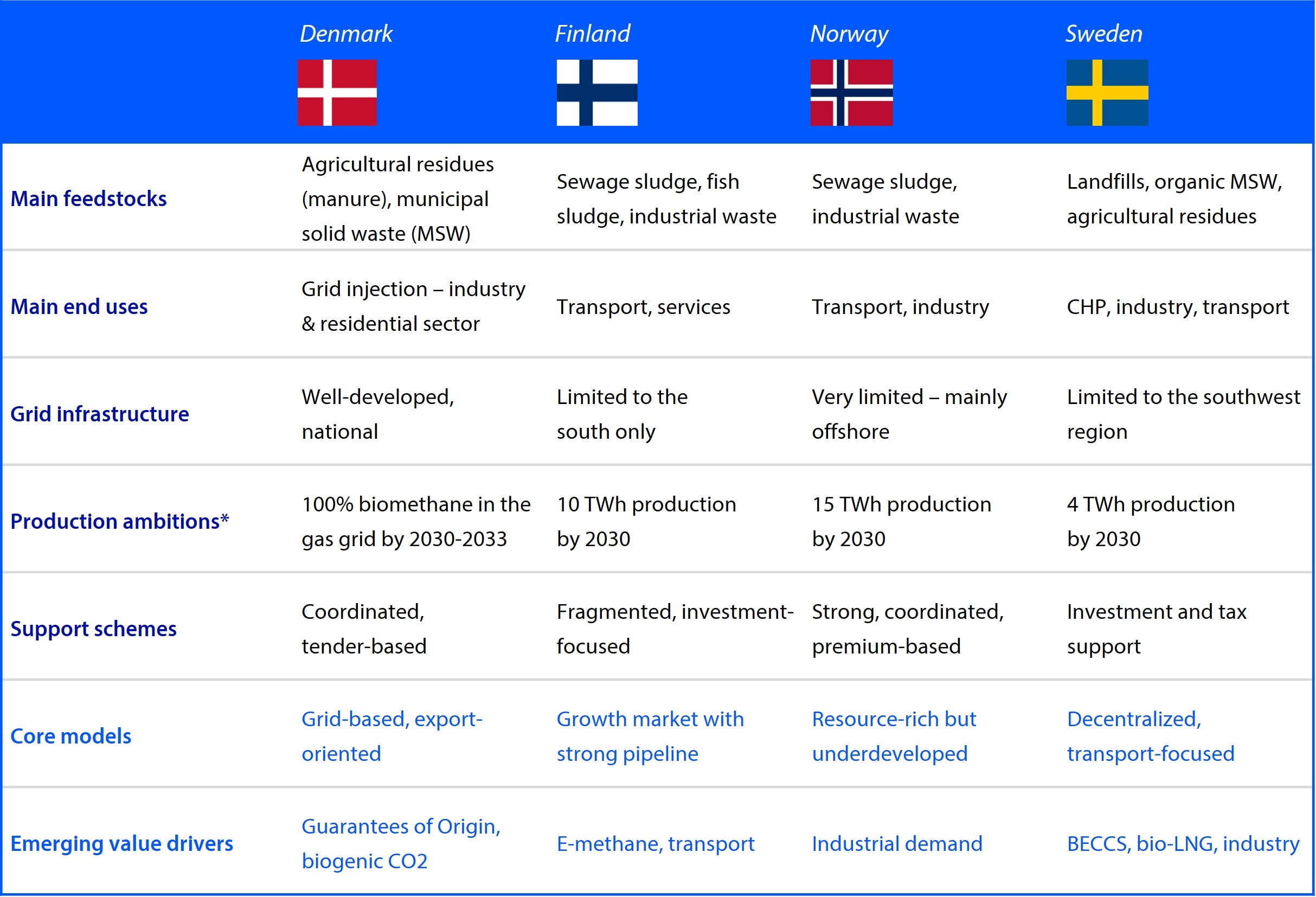
Biomethane deployment across the Nordics has followed four distinct pathways (see table 1). Although the countries share many structural similarities, policymakers have made different choices regarding infrastructure, support schemes and target sectors, resulting in different market models.
Resource availability alone does not explain why Denmark has become one of Europe's leading biomethane producers, why Sweden developed a transport-oriented market, why Finland is rapidly building a project pipeline from a relatively small base, or why Norway continues to underperform its estimated production potential (see figure 1 and 2). The more important factors have been policy choices, infrastructure investments and support mechanisms that shaped not only how much biomethane is produced, but also where it is consumed and how it is valued.
Table 1: Overview of key metrics in the biogas sector in the Nordics
Denmark represents the most mature and centralized model in the region. Rather than creating a dedicated compliance market for biomethane, policymakers chose to integrate biomethane into the national gas infrastructure. Support schemes for upgrading and grid injection, combined with a well-developed gas network and abundant agricultural feedstocks, enabled production to scale rapidly. Biomethane is now becoming a significant component of the country's gas supply and has increasingly become part of a broader strategy to decarbonize the existing gas system rather than replace it altogether. As production matures, future value increasingly comes from certificates and biogenic CO2 rather than additional production volumes. As seen in figure 1 and 2, Denmark has the highest production volume within the Nordics.
Sweden followed a different route. Limited gas grid coverage encouraged the development of local and regional biomethane value chains. As a result, Sweden has the most production facilities, dispersed over the country (see figure 1 and 2). Tax exemptions for biomethane in transport, combined with early investment in refuelling infrastructure, created one of Europe's most developed bio-CNG and bio-LNG markets. As a result, transport became the primary outlet for biomethane. However, recent outlooks suggest that the market is entering a new phase, with growing interest from industry and shipping as well as carbon removals through Bioenergy with Cabon Capture and Storage (BECCS).
Finland shares similarities with Sweden, particularly its limited gas infrastructure and strong focus on transport applications. Rather than relying on long-term production subsidies, Finnish policy has emphasized investment support, demand creation through transport obligations and the development of refuelling infrastructure. Production remains modest, but the development pipeline is substantial and imports of certified biomethane continue to increase, indicating that domestic demand is growing faster than supply. Its emerging position in e-methane and Power-to-X could become an important differentiator.
Norway presents a different picture. The country possesses unique resources, including residues from its aquaculture sector, and several studies point to a considerably larger production potential than current output. Yet biomethane has struggled to gain the same policy attention as electrification. Limited gas infrastructure, fragmented support mechanisms and an uneven regulatory framework have constrained development. As seen in figure 1 and 2, Norway has the lowest production volume and number of plants. While ambitions to increase production have gained political attention, Norway remains more of a potential future growth market than a mature biomethane economy today.
Taken together, these four markets illustrate that biomethane deployment is shaped as much by infrastructure, policy and market design choices as by feedstock availability.
Figure 1: Overall biogas production and number of plants per country in 2023

Figure 2: Overall biomethane production and number of plants per country in 2023

Beyond the fuel: The rising value of molecules, certifications and circularity
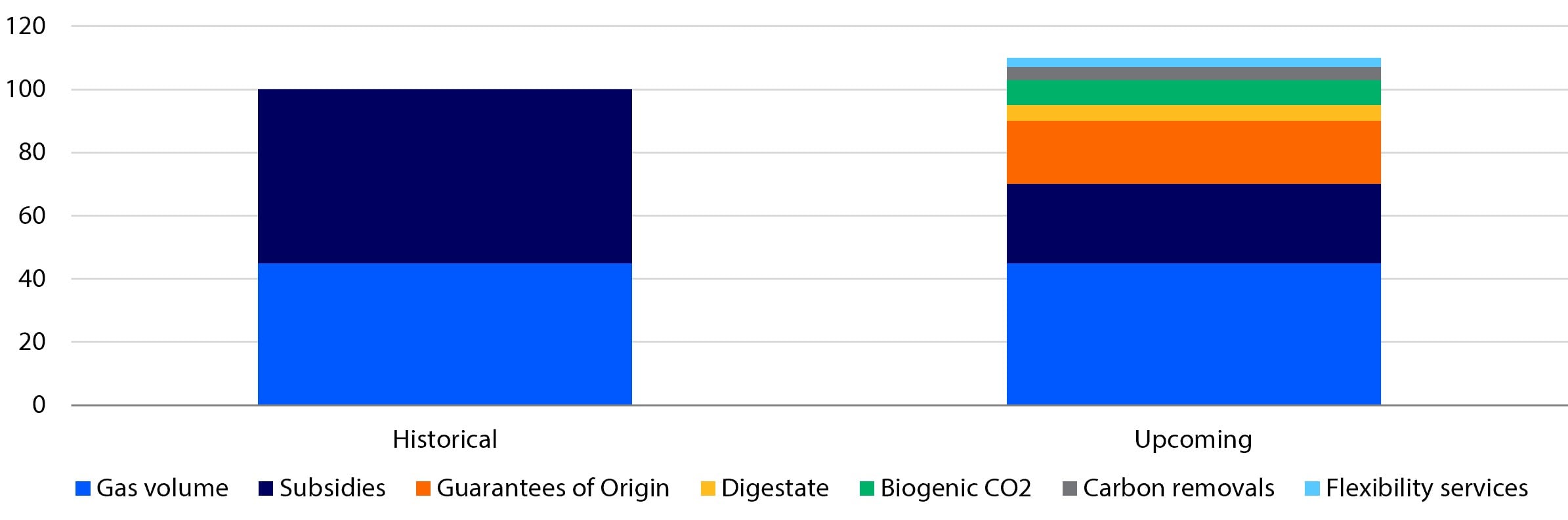
For much of the industry's history, the economics of biogas projects were relatively straightforward. Revenue was generated through gas sales, often supplemented by production subsidies or feed-in support. As long as policy incentives remained in place, project viability largely depended on production volumes. This model is gradually changing as biomethane markets mature (see figure 3). The question is no longer simply how much renewable gas could be produced, but how added values could be monetized and allocated to the suitable markets.
While Denmark has built a market around certificates, Sweden is exploring carbon removals, Finland is positioning around e-methane and Norway still faces the challenge of monetizing its resource base.
Figure 3: Illustrative change of revenues from biomethane production
Certificates: separating the environmental value from the molecule
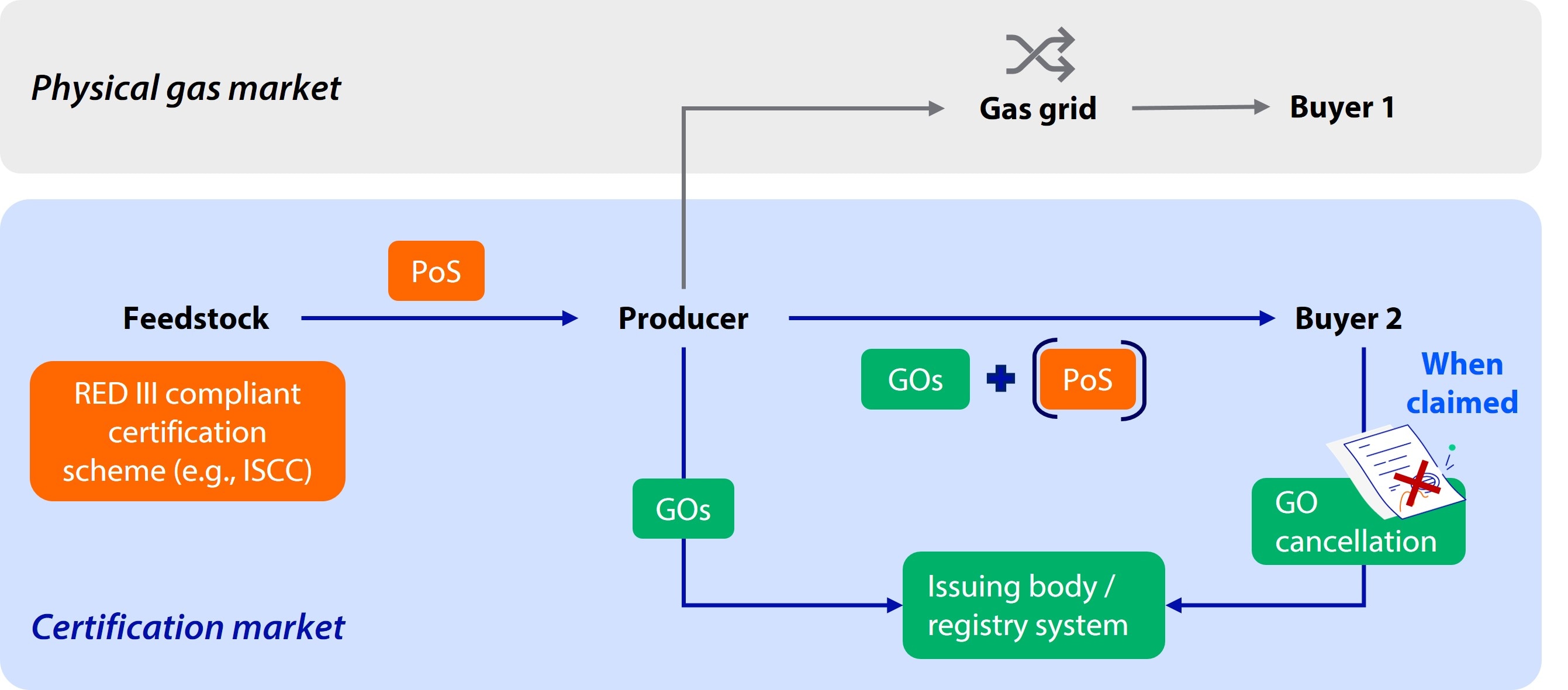
Guarantees of Origin (GOs), are electronic certificates that prove a specific quantity of renewable energy has been produced. National registries issue one GO per MWh of renewable energy and the certificate can then be transferred, traded or cancelled as proof of renewable gas consumption. Once biomethane enters the gas grid, it is physically indistinguishable from natural gas, so the GO carries the renewable attribute separately from the molecule itself (see figure 5). This allows the renewable attribute to be traded independently from the physical gas. GOs are intended to demonstrate to a final customer that a given share or quantity of energy was produced from renewable sources and therefore they primarily serve disclosure and renewable-origin claim purposes. For gaseous renewable fuels, however, GOs are often traded together with a Proof of Sustainability (PoS) to help avoid double counting and to preserve the link between the renewable attribute and the sustainability characteristics of the gas.
Figure 4: Overview of GO and PoS certificates
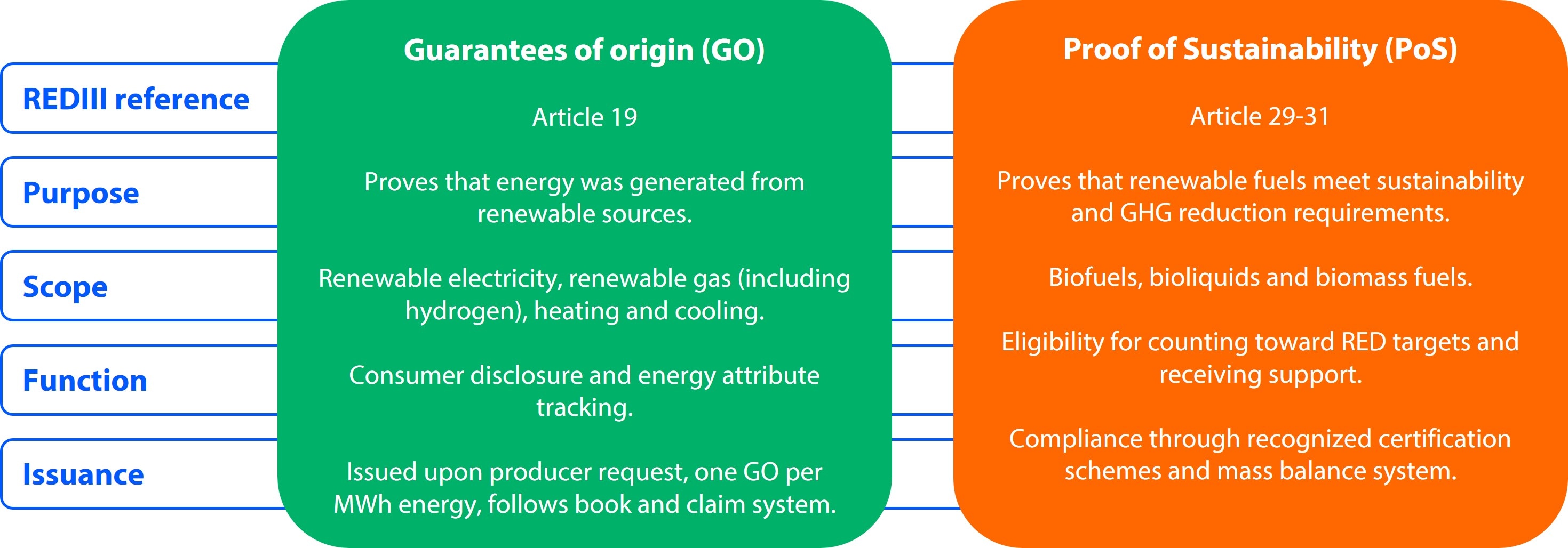
For compliance markets such as RED III transport targets, national fuel obligation schemes and part of EU ETS, sustainability and greenhouse gas reduction (GHG) requirements must be demonstrated through a PoS and the associated chain-of-custody documentation (see figure 4). A GO may accompany the transaction, but compliance is based on the sustainability certification rather than the GO itself. By contrast, where the objective is customer disclosure or making a renewable gas claim, a GO is generally sufficient.
Hence, it is important to distinguish GOs from sustainability certificates. While a GO demonstrates renewable origin to a final customer, sustainability certificates document compliance with the REDIII sustainability and GHG reduction criteria and are used for regulatory compliance purposes.
Cross-border trading adds another layer. In principle, GOs allow the renewable attribute of biomethane produced in one country to be claimed by a buyer in another, even when the physical gas molecule remains in the original grid. In Europe, this is supported by systems such as the Association of Issuing Bodies (AIB), which operates the European Energy Certificate System and gas GO scheme, and ERGaR, whose Certificate of Origin scheme enables transfers between participating renewable gas registries. These systems help reduce double counting and make cross-border certificate trade more transparent, but the market is not yet fully harmonized throughout the EU. Until this harmonization happens – through the Union Database –, countries with a well-functioning registry system, that is connected to either of the registries, could leverage cross-border trading.
Among the Nordic countries, Denmark has benefited the most from the development of cross-border certificate markets, while Sweden and Finland increasingly rely on imported certified biomethane to meet growing demand.
Figure 5: Simplified illustration of separate trading flows of physical biomethane and certificates
Digestate: From by-product to resource
Anaerobic digestion produces digestate, a nutrient-rich residue that can substitute mineral fertilizers and help recycle nutrients back into agricultural systems. Its strategic importance is increasing, as policymakers place greater emphasis on circularity, nutrient recovery and reducing dependence on imported fertilizers. According to the EBA, the digestate produced annually in Europe could theoretically replace more than 16% of mineral nitrogen fertilizer use and around 30% of phosphorus demand.
This aspect is particularly relevant in the Nordics, where biomethane production is closely linked to agriculture and manure management. In Denmark, digestate contains nutrients equivalent to around 30% of national mineral nitrogen use and more than 100% of phosphorus demand, while Norway's digestate resources could theoretically replace one-third of mineral nitrogen consumption. Sweden and Finland show lower substitution rates, but digestate remains an important source of recycled nutrients in increasingly circular food and energy systems.
The value proposition may strengthen further following the adoption of the RENURE amendment in 2026, which allows certain manure-derived nutrient products to exceed the traditional Nitrates Directive limit under specific environmental conditions. This could improve the economics of nutrient recycling technologies and increase the value of digestate-derived products, particularly in livestock-intensive regions such as Denmark.
Biogenic CO2: An emerging utilization market
Biogenic CO2 is the carbon dioxide released from biological material. In biomethane production, it is separated from methane during the upgrading process. Today, it is increasingly being viewed as a feedstock. This CO2 can be purified and liquefied for use in food and beverage applications, greenhouses or industrial processes. It can also be combined with renewable hydrogen to produce e-methane or e-methanol.
Denmark and Finland increasingly view biogenic CO2 as a strategic feedstock rather than a by-product. Denmark focuses on CCUS, while Finland's emerging e-methane projects point toward a closer integration between biomethane and synthetic fuel value chains. This is where the biomethane story starts to overlap with hydrogen and e-fuels. A biogas plant can become a supplier of renewable methane, green CO2 and feedstock for industrial processes. Upgrading biogenic CO2 into a pure, marketable feedstock comes with additional processing, purification, liquefaction and transport costs. Consequently, producers face a growing choice between selling CO2 into utilization markets or storing it permanently to generate carbon removals.
Carbon removals and BECCS
BECCS, captures biogenic CO2 and stores it permanently underground. Because the carbon originated from biomass, permanent storage can generate negative emissions. In other words, BECCS can remove CO2 from the atmosphere, under stringent removal calculation methodologies, rather than merely avoiding new fossil emissions.
For biomethane specifically, BECCS is still less mature than for large biomass-fired heat and power plants or pulp and paper facilities. But the logic is relevant: biomethane plants already produce a separated biogenic CO2 stream. If storage infrastructure, certification and carbon removal markets develop further, this could become a future revenue stream for larger biogas facilities, especially in Denmark.
Sweden has emerged as one of Europe's most active countries in developing policies for BECCS, while Denmark is exploring the role of carbon capture within its broader climate and energy strategy.
The dynamics of Denmark’s certificate market
What makes the Danish biomethane market particularly interesting is not only the physical gas and production volumes[1] but also the market that has emerged around the certifications.
The development of Denmark's GO market illustrates how renewable value increasingly moves independently from physical gas flows. In practice, the Danish system links Guarantees of Origin (GOs) and Proofs of Sustainability (PoS) through the Energinet registry, helping ensure traceability and reducing the risk of double counting.
Figure 6 shows that Sweden has historically been the largest destination for Danish GOs, reflecting the importance of certified biomethane in the Swedish market. More recently, however, demand has become increasingly diversified, with growing exports to other European countries. At the same time, domestic cancellations have remained comparatively stable, between 12% and 18%. This suggests that the growth in certificate demand is increasingly being driven by buyers outside Denmark, reinforcing the country's position as a supplier of renewable gas attributes while also highlighting the ongoing debate about where the value associated with biomethane should ultimately be captured.
[1] In July 2026, for the first time, biomethane, injected to the grid, fully covered the national gas demand. Even though the demand in summer is lower than in winter, it clearly signals that Denmark is on the right path to reach the ambition of a 100% green gas system by 2030.
Figure 6: Cancelled and exported biomethane GOs in the Danish registry system by destinations
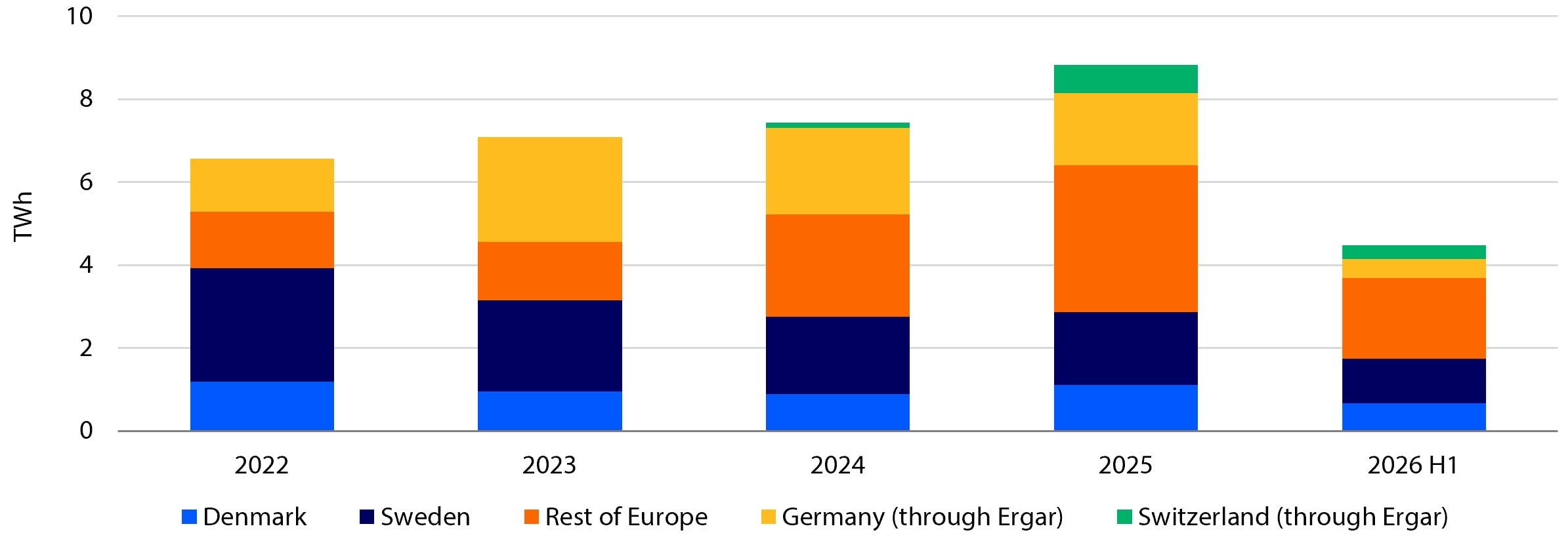
Source: Energinet 2026
The emergence of this export market is not simply the result of strong demand abroad. It is also the consequence of a deliberate policy choice. Danish support schemes are designed to avoid double support, meaning that producers receiving subsidies cannot automatically combine those payments with the full value of GOs for the same production volume. This creates a clear distinction between subsidized and unsubsidized production and strengthens the credibility of the certification system.
The approach offers several advantages. It protects the integrity of public support schemes, reduces the risk of overcompensation and provides confidence that renewable attributes are claimed only once. At the same time, it also creates a challenge. If foreign buyers can derive more value from Danish biomethane than domestic consumers, the associated GOs and, where applicable, the sustainability attributes documented through a PoS, will naturally flow abroad. This is particularly the case when sustainability-certified biomethane is used for RED III transport compliance, national fuel obligation schemes or ETS-related decarbonization strategies in other countries. In that case, Denmark captures the investment, employment and production benefits associated with biomethane generation, while part of the value linked to renewable energy claims and regulatory compliance is realized elsewhere.
This tension is increasingly shaping discussions about the next phase of biomethane development. Danish industry stakeholders argue that stronger domestic incentives for sustainability-certified, unsubsidized biomethane could help unlock additional production without relying solely on subsidies. Such measures could redirect more certificate value to domestic consumers and producers while supporting Denmark's ambition of a fully green gas system.
The implications would extend beyond Denmark. Danish biomethane certificates have helped satisfy renewable gas demand in neighboring markets, particularly Sweden and Germany. If domestic incentives encourage more Danish consumers to cancel GOs and use certified biomethane themselves, fewer certificates would be available for export. In that scenario, countries and companies that have relied on Danish renewable gas attributes would need to adjust their sourcing strategies. They could turn to other certificate-exporting markets, but they could also face stronger incentives to develop domestic biomethane production capacity of their own. In effect, a shift in Danish market design would not only redistribute certificate flows; it could influence investment decisions and production growth across Northern Europe.
Denmark therefore offers a broader lesson for Europe. Certificates are more than administrative tools for traceability; they are market-design instruments that determine how renewable and compliance value is allocated. The Danish model demonstrates the benefits of transparent certification and safeguards against double support, but it also highlights the trade-offs between domestic market development and cross-border trade. Ultimately, the next phase of biomethane growth will depend not only on producing renewable gas, but on designing markets that allocate its value efficiently and transparently.
Where biomethane is the most valued?
The value of biomethane increasingly depends on where it is used, not only where it is produced. A MWh sold into a general heating market does not necessarily carry the same value as one used for transport compliance, industrial decarbonization or maritime fuel substitution. The strongest business cases are likely to emerge where certified biomethane solves a difficult decarbonization problem and where regulation creates a clear willingness to pay.
This also helps to explain the different Nordic pathways. In Sweden, Finland and Norway, transport has historically been the main value pool due to compliance under the Renewable Energy Directive. Sweden built one of Europe’s most developed bio-CNG and liquefied biomethane markets, supported by tax exemptions, production premiums and a broad refueling network. Finland is following a smaller but similar route, with demand supported by the transport fuel obligation and growing interest in liquefied biomethane for heavy-duty transport and maritime use. Norway also directs much of its biomethane to transport, but rapid electrification and limited gas infrastructure constrain the market.
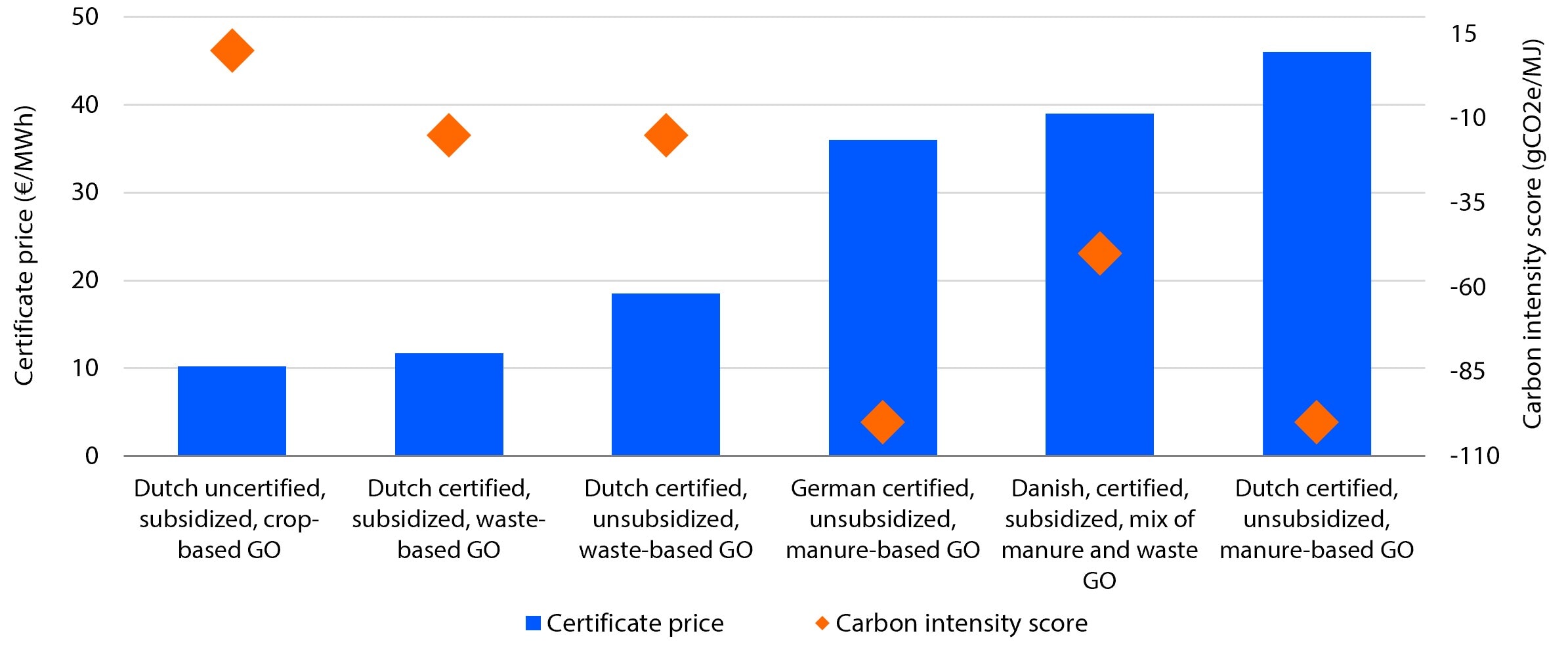
Transport has been attractive because it offers compliance-driven demand. Under RED III, renewable fuel value is increasingly linked to greenhouse gas reduction performance rather than only energy volume. This favors biomethane from manure, waste and other residues with strong emissions savings. The emission saving performance of biomethane is expressed through the carbon intensity score (CI). Market data shows how manure-based, residual or waste-based and crop-based biomethane serve different end-markets and carry different value profiles (see figure 7).
Maritime demand may add another premium market. LNG use in shipping is expanding, while the FuelEU Maritime Directive is increasing the demand for lower-carbon marine fuels. This could support liquefied biomethane in Sweden and Finland, where liquified biogas (LBG) infrastructure and project pipelines are already developing. Stronger demand from the maritime sector has already been visible, especially for manure-based biomethane that has a higher GHG saving potential, thus suits better to comply with the GHG reduction requirements of the Directive.
Figure 7: Connection of biomethane certificate prices and their CI score in July 2025
Industry could become the next major value pool. Many industrial users still require gaseous fuels for high-temperature heat, process energy or feedstock use. Sweden is a relevant example; industry accounts for a large share of total gas demand, while the biomethane share remains relatively low. Denmark’s grid-based model is also well-suited to industrial demand, particularly if domestic incentives for certified biomethane improve.
Heating and power remain relevant, but their value proposition is more mixed. In highly electrified energy systems, biomethane may struggle as a general heating fuel. Its role is stronger where it substitutes fossil gas in existing networks, provides peak-load capacity or supports system flexibility. Denmark is the clearest Nordic example of using biomethane to decarbonize the gas grid itself, as well as to support reliability when wind and solar output are low.
Overall, biomethane value follows policy recognition, carbon exposure, and infrastructure access. For the Nordics, this means that the demand will not only materialize in transport as it did in the past decade, but increasingly in the maritime and industrial sectors.
The next phase of biomethane has already begun in the Nordics
The Nordic countries offer an early glimpse into the questions that are beginning to shape Europe's biomethane sector. The challenge is no longer solely to produce more renewable gas. Increasingly, success depends on creating markets capable of recognizing, certifying and rewarding the different values associated with biomethane.
Across the region, policymakers and market participants are already testing different approaches. Denmark is navigating the trade-offs between certificate exports and domestic value creation. Sweden is exploring how biomethane can connect with carbon removals and the maritime sector. Finland is linking renewable gas with emerging e-fuel value chains, while Norway continues to search for the market conditions needed to unlock its resource potential.
These developments illustrate a broader shift. Biomethane is evolving from a renewable substitute for natural gas into a platform for multiple environmental and economic services: emissions reduction, nutrient recycling, carbon management and fuel production. As a result, future competitiveness may depend less on production costs alone and more on the ability to connect these values to the sectors that need them most.
For Europe, the Nordic experience suggests that the next generation of biomethane markets will be defined not by molecules alone, but by how effectively their wider environmental value can be recognized and monetized through deliberate policy and market designs.