Research
A new strategy playbook for the US power industry

US power and data center companies are pursuing integrated platforms and acquisitions to secure timely electricity, expand capacity and capabilities, and become long-term energy partners as demand grows.
Summary
Introduction
Rising electricity demand, driven predominantly by data centers, is creating a larger market for US power companies. Meeting that demand, however, requires generation and grid infrastructure that involve large capital investments and can take years to deliver. The gap between growing demand and the ability to deliver supply is influencing growth strategies across the power industry and among its customers and investors.
Mergers and acquisitions announced or completed since late 2025 show how power companies, technology companies, and infrastructure investors are positioning themselves to meet data centers’ growing need for reliable, round-the-clock electricity. Acquiring operating power plants gives buyers access to existing generation while waiting for new construction. Other transactions add development capabilities, investment capital, and closer connections to data center customers. Together, these strategies point toward integrated power platforms that can supply power today and develop additional capacity as data center customers expand.
Power delays put data center revenues and investment returns at risk
As discussed in our US power demand outlook, we project electricity consumption growth of up to 20% by 2030. In The sprint, we explained that data center construction can take 12 to 24 months, while some grid connections require three to seven years. Supply chain bottlenecks also limit how quickly new power plants can be built. For example, large gas turbines can have delivery wait times of up to seven years, while GE Vernova, a major turbine manufacturer, has reported a global gas power equipment backlog and production-slot reservations totaling 116 gigawatts (GW).
These delays can reduce the economic value of investments by large technology companies, or hyperscalers. Once a data center is built and its computing equipment is installed, every month without electricity is a missed opportunity to earn revenue. For an artificial intelligence (AI) data center, annual revenue could be as much as USD 10 billion per gigawatt of computing capacity.[1] NVIDIA estimates that its computing systems represent roughly 60% to 70% (USD 35 billion) of the total capital cost of an illustrative 1GW artificial intelligence data center. For a facility of this scale, annual equipment depreciation could reach USD 7 billion.[2]
Delays leave less productive time to recover that investment, as newer chips constantly make installed equipment less competitive. Faster access to power gives operators more time to earn revenue and recover their investments during the equipment’s useful life. An on-site power premium of approximately USD 10 to 75 per megawatt-hour (MWh) over grid supply adds roughly USD 88 million to USD 657 million to annual electricity operating costs at a continuous 1GW draw.[3] That premium can be justified by the additional earnings from starting sooner, particularly because the equipment continues to depreciates once it is running.
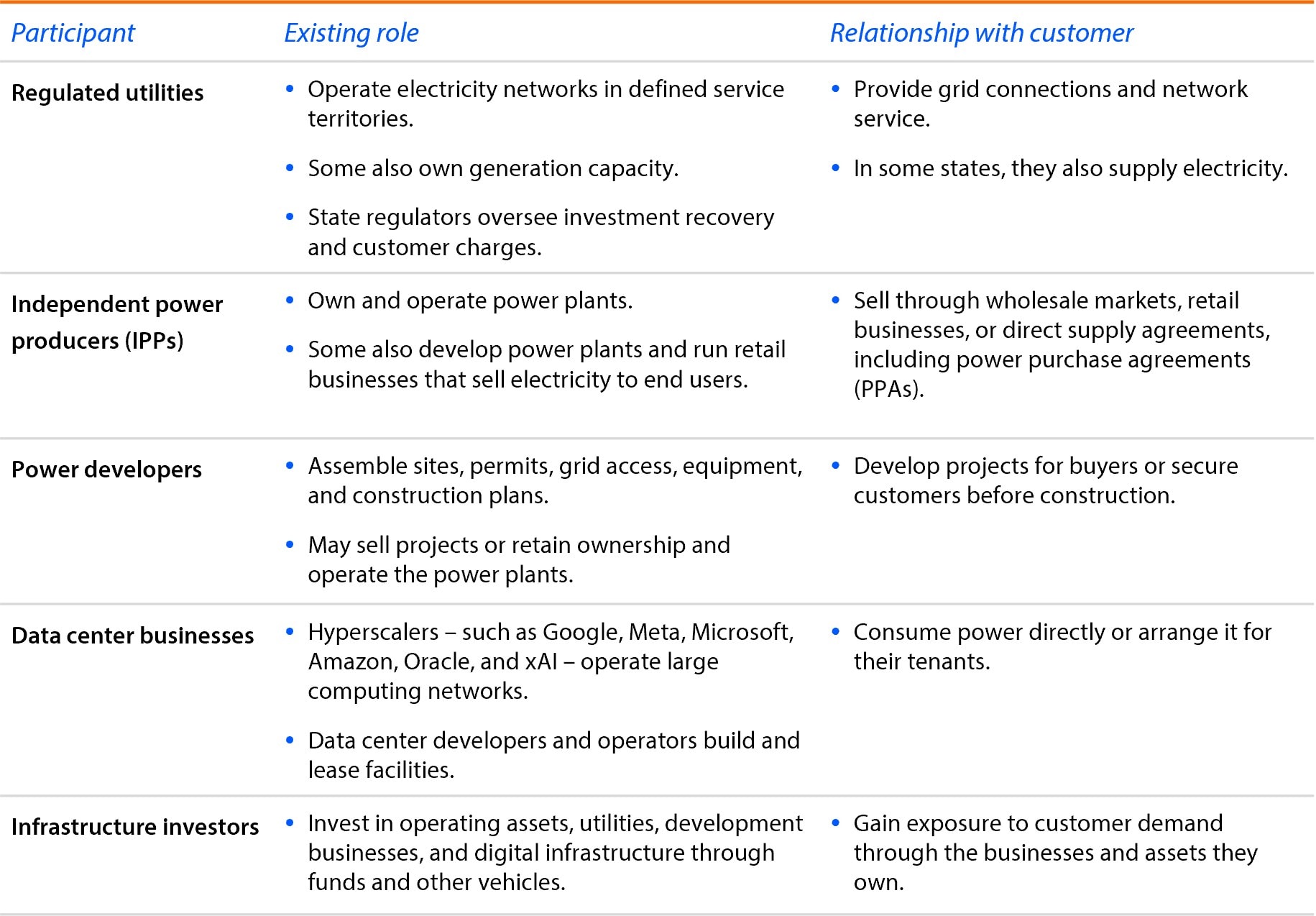
Delivering power on time requires generation, grid access, development expertise, and capital. The businesses currently providing these capabilities occupy different positions in the power supply value chain (see table 1).
[1] IREN’s USD 9.7 billion Microsoft contract covers a five-year term and 200MW of computing load. Annualizing and scaling to 1GW implies USD 9.7 billion per year, rounded to USD 10 billion. This is a contract-based illustration, not an industry average. Computing load excludes cooling and other facility loads, unlike the total facility draw used for the electricity-cost illustration.
[2] Illustrative calculation using NVIDIA’s USD 35 billion equipment estimate within a USD 50 - 60 billion total development cost, an assumed five-year useful life, straight-line depreciation and no residual value. This is an annual capital-cost benchmark, not additional cash losses caused by a power delay. Revenue and depreciation are not additive measures of delay costs.
[3] Illustrative calculation using a USD 10 to USD 75 per MWh premium, informed by the on-site and grid power cost ranges published in The sprint. Applied to a continuous 1GW draw for 8,760 hours in a year, this equals USD 87.6 million to USD 657 million annually. Actual premiums depend on the project and supply arrangement.
Table 1: Key businesses in power supply value chain
Mergers and acquisitions strengthen companies’ ability to meet growing power demand
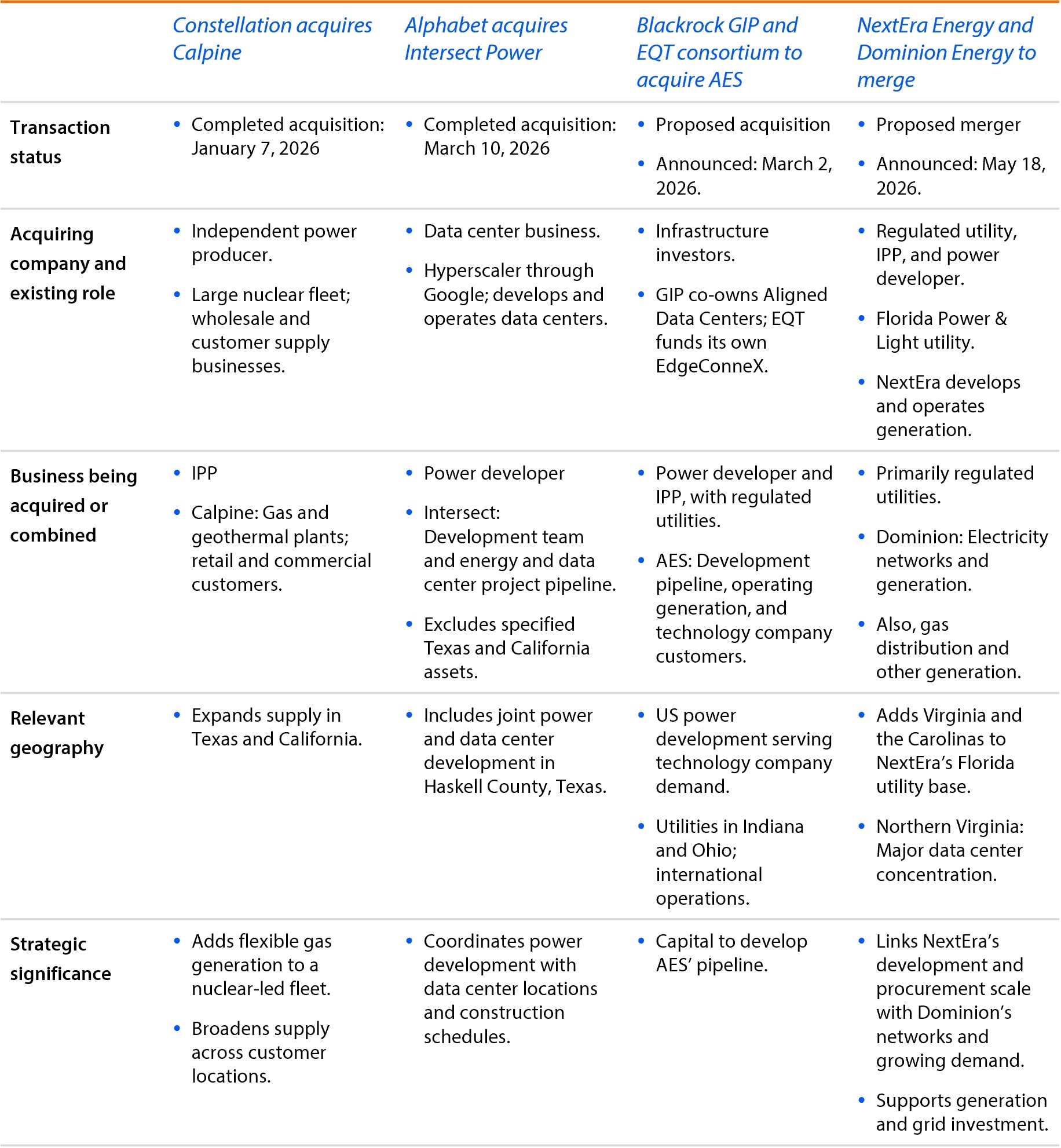
Companies across the power supply value chain are using mergers and acquisitions to position themselves to meet growing power demand in an increasingly squeezed market. These transactions expand their scale, strengthen existing capabilities or add new ones, and improve access to capital and customers (see table 2).
Table 2: Selected recent mergers and acquisitions announced and their strategic significance
Constellation’s larger generation fleets strengthen the ability to supply customers around the clock
Constellation’s 55GW combined fleet pairs its significant nuclear portfolio with Calpine’s gas plants, which can adjust output as needed. This broadens its options for supplying reliable, round-the-clock electricity to data centers.
A fleet spanning several markets also strengthens Constellation’s ability to serve hyperscalers developing multiple campuses, with supply tailored to each location’s electricity needs, emissions objectives, and delivery timetable. Competitor NRG’s acquisition of approximately 13GW from LS Power illustrates a similar expansion. These acquisitions transfer ownership of operating plants without increasing total US generating capacity.
Alphabet gains greater control over the timing of power and data center development
Intersect’s development team and project pipeline give Alphabet greater control over developing power and data centers together. Alphabet can choose data center locations with power availability in mind and coordinate equipment orders and construction schedules across both developments. This can reduce the risk of completing a data center before its electricity supply is ready.
Infrastructure investors connect AES’s power pipeline with capital and potential customers
The Blackrock Global Infrastructure Partners (GIP) and EQT-led consortium would provide capital to develop AES’s pipeline of power projects. AES already has established demand, including 11.8GW of signed supply agreements with major technology companies.
The strategic opportunity is to combine infrastructure investors’ capital with AES’ established development capabilities and customer commitments. This would support the development of its power project pipeline and provide a foundation for further growth.
NextEra’s development capabilities would gain a larger customer base in high-demand territories
NextEra’s development experience, equipment purchasing scale, and financing capacity would support investment in Dominion’s Virginia and Carolinas territories, including Northern Virginia’s concentration of data centers. The proposed combination would serve approximately 10 million utility customer accounts and own 110GW of generation. Its opportunity lies in applying those capabilities to the power plants and grid expansion needed in these markets.
State utility commissions overseeing Dominion’s regulated utilities review investment plans and determine which costs can be recovered through electricity bills. The merger also requires their approval, alongside federal approvals. Greater purchasing scale and coordinated construction could contain project costs. With infrastructure expansion putting pressure on bills, the case for the combination rests partly on meeting growing demand while limiting the costs passed on to households and businesses.
Companies are moving toward platforms that connect power supply with customers
The transactions discussed above point toward a common direction. Companies are combining greater control over power supply with closer access to customers. They bring together operating plants, development capabilities, capital, and customer relationships to meet electricity demand.
Companies are strengthening these connections from different starting positions (see figure 1):
Figure 1: Strategic positioning across power supply and customer access
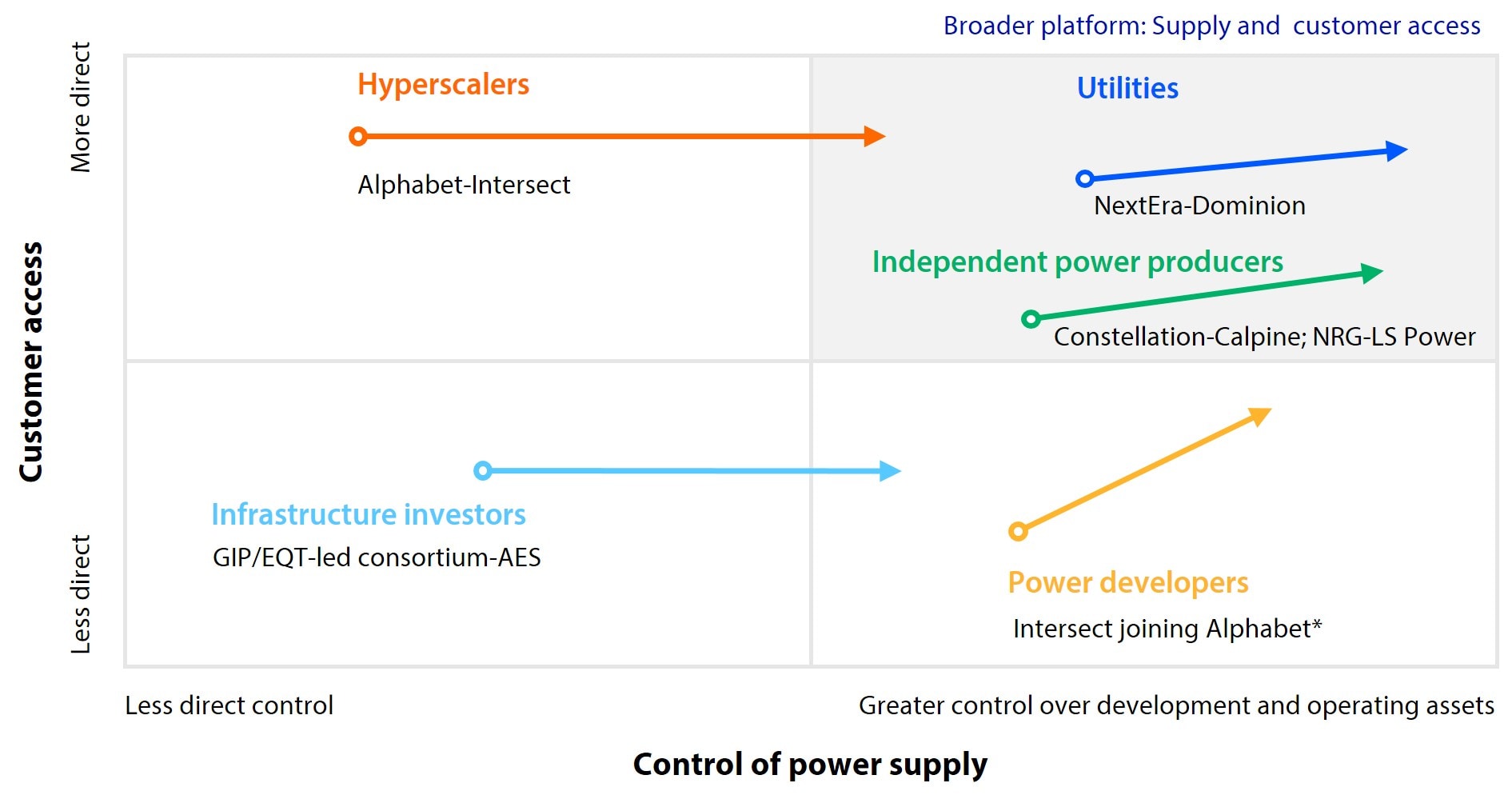
Combining these capabilities can help businesses coordinate where to invest, when to order equipment, and how to schedule construction. For power suppliers, earlier knowledge of a customer’s expansion plans can guide project development and procurement. For data center businesses, greater influence over power development can help align new electricity supply with the opening of their data centers. The commercial benefit is a closer match between investment in supply and the demand expected to support it.
The implications for electricity supply nevertheless differ. Acquiring operating plants gives a buyer control over existing capacity, while developing new projects can increase the electricity available to customers. The next question is how quickly each route can meet growing demand.
Acquisitions secure existing capacity while expansion and construction add supply
The platforms emerging from these transactions combine access to existing generation with capabilities to develop future supply. Their immediate opportunity is to secure power for data centers that cannot wait for new plants to be developed. Supporting continued growth also requires additional capacity, through plant restarts, expansions, and new construction (see figure 2).
Selected acquisitions of gas-fired power plants since September 2025 imply costs of approximately USD 850 to USD 1,600 per kilowatt (kW), based on the announced prices for Cogentrix’s generation portfolio and Hill Top, a gas-fired plant in Pennsylvania. By comparison, Lazard’s July 2026 report cites construction-cost quotes of USD 2,400 to 2,600 per kW for new combined cycle gas plants expected to enter service after 2028. Available operating plants are therefore the low-hanging fruit for buyers, offering lower upfront costs and immediate revenue. Their value for data centers depends on whether their electricity is available to contract and can reach the locations where it is needed.
Figure 2: Capacity and timing of selected US gas plant acquisitions, nuclear restarts and expansions, and new gas plant constructions
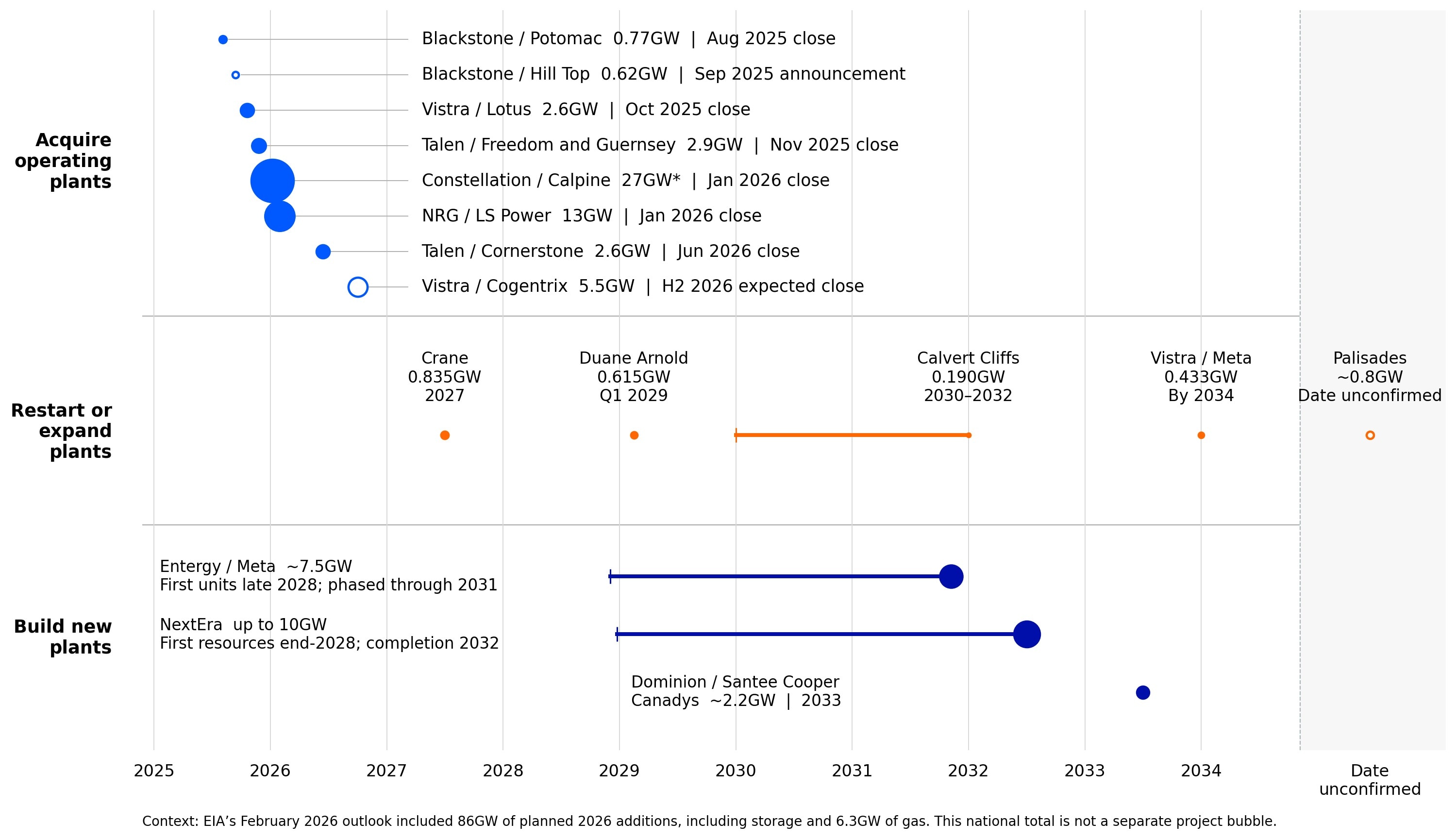
Hyperscalers’ long-term commitments to buy electricity are also supporting the return and expansion of nuclear generation. Constellation plans to restart the closed 835MW Crane nuclear plant in Pennsylvania in 2027, supported by its agreement with Microsoft. Vistra, another independent power producer, has agreements with Meta supporting 433MW of additional nuclear capacity through upgrades to operating plants, with full delivery expected by 2034.
New construction adds supply beyond what can be restored or added at existing plants. NextEra’s planned program of up to 10GW of gas generation in Texas and Pennsylvania targets initial capacity as early as the end of 2028 and completion in 2032. Across restarts, expansions, and new construction, these long-term electricity purchase commitments reduce uncertainty about demand before producers commit to major spending. For hyperscalers, those commitments provide a way to secure future supply and support their data center expansion.
How companies combine access to existing generation with new development will shape their longer-term role in serving data centers.
Integrated platforms are positioning themselves to become long-term energy partners
Power supply and data center development are becoming more closely coordinated. Hyperscalers are bringing power development into their businesses, while suppliers and infrastructure investors are assembling broader capabilities to serve them. We expect this integration to make responsibility for delivering power increasingly important to competitive advantage.
Companies with available generation in high-demand locations have an immediate opportunity to secure long-term supply commitments. Those agreements can provide reliable power for hyperscalers and a basis for power suppliers to invest in further capacity. As supply catches up with demand in individual markets, the premium for immediate access to electricity should ease. Companies that use today’s supply and demand dynamic to their advantage will be better positioned to establish continuing roles in hyperscalers’ expansion plans and sustain growth.
We expect the emerging supplier platforms to evolve toward an integrated energy-service model. They would commit to meeting data centers’ long-term power needs within agreed reliability, timing, and cost requirements, drawing on acquired plants, electricity purchases, and new development. The lasting advantage would lie in fulfilling that commitment as demand changes, extending the relationship beyond any individual plant or contract.