Research
CCUS and natural gas: three pathways to scale, but with limits

CCUS is most likely to scale in applications where infrastructure access, high utilization, and supportive economics converge.

Summary
Where does CCUS stand in North America?
Carbon capture, utilization, and storage (CCUS) refers to a suite of technologies that capture carbon dioxide emissions from industrial processes or directly from the air, and stores them underground or repurposes them for industrial use (see Table 1). Historically, CCUS has been most widely deployed in the oil and gas sector, particularly for enhanced oil recovery (EOR), where captured CO₂ is injected into fossil fuel reservoirs to improve extraction rates. More recently, it has emerged as a tool to decarbonize hard-to-abate sectors such as power generation, cement, steel, and refining. Read more on CCUS technologies and its value chain here.
Table 1: Types of carbon capture technologies

Note: This table excludes nature-based carbon removals like enhanced weathering, ocean carbon removal, and carbon mineralization.
Source: International CCS Knowledge Centre, US Department of Energy, Klimate, RaboResearch 2026
Despite this expanding role and growing policy support, large-scale CCUS deployment across North America remains constrained. Only about a quarter of the announced capture capacity in North America has progressed to a final investment stage or later (see Figure 1). The majority is located in the US.
Figure 1: North American carbon capture capacity by project status

High capital costs, fragmented transport and storage infrastructure, and permitting delays continue to limit project development. As a result, a gap persists between the strategic importance of CCUS and its pace of deployment.
Rising power demand, driven by data centers, electrification, and reliability needs, is reinforcing the role of natural gas in the US and Canada. This could support CCUS where stable and lower-emission power is required. However, stronger gas demand does not address the structural barriers that have constrained CCUS deployment.
The key question is whether CCUS can scale. Deployment depends on how economics, infrastructure access, and asset utilization align across applications. These factors determine whether CCUS remains selective or expands more broadly.
Three pathways for CCUS deployment
While policy support, economics, infrastructure access, and utilization influence all CCUS projects, their relative importance differs per application. Three pathways illustrate these differences by highlighting the primary constraint in each:
- The first pathway is in the existing industrial market, where CCUS is already commercially established.
- The second is utility-scale natural gas power generation paired with CCUS, which offers potential for emissions reduction but remains economically and operationally unproven at a large scale.
- The third is an emerging application: gas-fired generation for data centers, where reliability needs are high, but asset utilization profiles may not align with CCUS requirements.
Policies, regulations, incentives and carbon markets remain a prerequisite across all three pathways rather than a distinguishing factor.
Pathway 1: Existing industrial market – a mature CCUS pathway constrained by policy and infrastructure
The most established pathway for CCUS deployment in North America spans a range of industrial applications, including natural gas processing, refining, hydrogen, ammonia, ethanol, and EOR. EOR provides a key economic advantage: captured CO₂ has a direct revenue-generating use. In addition to this revenue stream, these applications benefit from decades of technical expertise, existing CO₂ pipeline networks, and a mature commercial framework for managing captured emissions. As a result, it remains the most commercially viable CCUS application in North America.
Policy incentives in both the US and Canada have played a key role in supporting EOR economics with tax credits, although each country has a different approach (see Table 2). In the US, the federal 45Q tax credit has been a major driver for project development. The credit currently provides up to USD 85 per metric ton of CO2 (mtCO2) captured and stored or utilized from industrial facilities or power plants. Additionally, the current administration increased the value of 45Q for EOR from USD 60/mtCO2 to USD 85/mtCO2, while other renewable energy tax credits faced drawbacks. The change reflects continued support for natural gas-related decarbonization initiatives and provides greater certainty for CCUS investors.
Canada has similarly positioned CCUS as part of its industrial decarbonization strategy through the CCUS investment tax credit (ITC), which applies to qualified CCUS expenditures incurred from January 1, 2022 to December 31, 2040. The Canadian government recently extended the credit by five years from 2035 to 2040 and now allows EOR projects to qualify for the credit, while also committing more than CAD 300m in federal funding support for CCUS-related initiatives. Although policy support for CCUS has strengthened across North America, infrastructure and permitting constraints continue to limit expansion.
Table 2: Comparing US and Canadian CCUS tax credits

Note: ‘DAC’ is direct air capture.
Source: Government of Canada, RaboResearch 2026
Both markets face infrastructure challenges regarding the transport and storage of captured carbon. Project developers are announcing more capture capacity than storage capacity. Across North America, planned capture capacity for late and early-stage projects is nearly double planned storage capacity in those same stages, suggesting storage development may become a bottleneck for future deployment (see Figure 2). Transport capacity may appear sufficient, but proximity to capture and storage projects remains a challenge, leaving some projects without access to pipelines or sequestration hubs.
Figure 2: Planned capture capacity is outpacing storage capacity in North America

The US is home to a larger and more mature CO2 pipeline network than Canada. Much of the infrastructure remains concentrated in the central southern portion of the country (see Figure 3). The completed and active pipelines are concentrated in Texas, which is not surprising given it is the hub for oil and gas operations in the US. As a result, project connectivity varies significantly by region, with some CCUS projects located near established transportation and storage networks, while others face infrastructure gaps. Read more on the US CO2 pipeline challenges here.
Figure 3: Map of existing and in progress US CCUS projects and pipelines
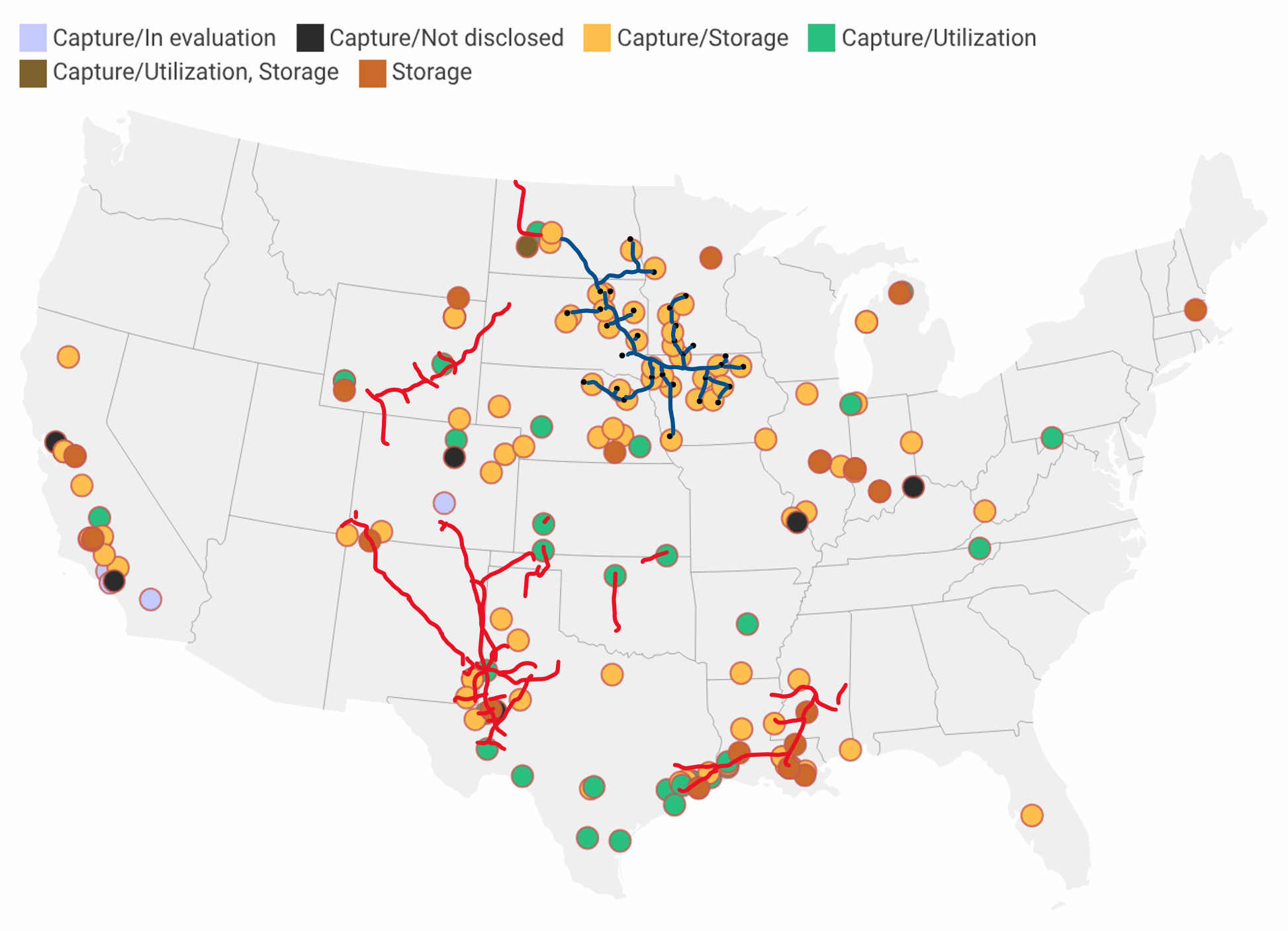
Note: Red indicates completed pipelines with some segments that may still be under development. Blue indicates pipelines under construction or consideration. The capture projects plotted include planned, under construction, and operational projects. Not drawn to scale.
Source: BloombergNEF, American Carbon Alliance, RaboResearch 2026
The US market continues to face permitting bottlenecks related to Class VI wells, which are required for permanent geologic CO2 storage. Developers depend on access to Class VI wells to secure the permitted sequestration required to qualify for 45Q. This creates a financing challenge for developers, as financiers require confirmed Class VI permits before funding projects. Therefore, lengthy permitting timelines continue to constrain project bankability and slow commercialization.
The Canadian CCUS market faces challenges more on a provincial level. The provinces have rights over pore spaces[1] which are needed to geologically sequester captured CO2. High-quality storage formations remain limited, creating competition for pore space access in several regions. Alberta, for example, retains ownership of pore space rights, requiring developers to lease sequestration rights from the provincial government before obtaining approvals for storage operations, pipelines, and related infrastructure. While the Canadian permitting process can be complex, the approval timelines have reportedly been shorter than the several-years-long US Class VI wells applications.
Scaling existing industrial applications for CCUS will continue to depend on resolving bottlenecks related to infrastructure and permitting. In the US, accelerating Class VI well approvals are critical to improving project bankability. In Canada, expanded carbon hub development and coordination at the provincial level will be key. While this pathway is not without challenges, it remains the only CCUS application with a clearly established commercial foundation.
Pathway 2: Utility-scale gas power – promising, but commercially unproven
Utility-scale power generation represents a potential new avenue for CCUS deployment. Pairing CCUS with natural gas-fired power plants could reduce emissions while preserving dispatchable generation and grid reliability.
However, project viability depends heavily on policy incentives/requirements or the willingness of buyers to pay a premium for low-carbon, firm power. Without a monetizable use for captured CO₂, CCUS in power generation operates primarily as a cost driver rather than a revenue-generating asset, which would be acceptable if there was a federal or state/provincial mandate incentivizing the adoption of CCUS.
Canada’s compliance carbon markets can provide an additional revenue stream for emissions reductions, strengthening the investment case for CCUS. While some US states operate carbon pricing programs, the absence of a federal framework means support for utility-scale CCUS remains more dependent on 45Q incentives and voluntary corporate procurement. RaboResearch will cover North America’s carbon markets in a separate piece.
While the levelized cost of electricity (LCOE) of combined-cycle gas turbine (CCGT) plants can remain cost-competitive with renewables in certain North American markets, the addition of CCUS could add over USD 40 in generation costs (see Figure 4).
[1] Pore spaces are underground geologic formations that can permanently store captured CO2.
Figure 4: North American 2025 LCOE comparison across technologies

In practice, this pathway remains nascent. Currently, power generation is not the dominant source of captured CO₂ in North America. In Canada, about 30%[2] of captured CO2 from late-stage projects[3] comes from hydrogen production, followed by about a quarter from power generation (see Figure 5), most of which is from a coal project. Meanwhile in the US, power generation trails natural gas processing and hydrogen (see Figure 6). Most importantly, there are no operational, large-scale commercial natural gas power plants paired with CCUS in North America. While several pilot projects have demonstrated technical feasibility, almost all large-scale projects announced are still pre-final investment, underscoring the early-stage nature of this solution.
[2] The value only includes captured CO2 from late-stage projects, which are projects that are under construction or operational.
[3] This includes both future and operational capture capacity.
Figure 5: Top 5 Canadian CC sources

Figure 6: Top 5 US CC sources

Despite its immaturity, there is appetite for this pathway in the market. Corporate energy buyers are beginning to explore alternatives beyond traditional renewable power purchase agreements (PPAs). For example, Google signed a landmark corporate offtake agreement for power from a natural gas-fired cogeneration plant paired with CCUS. The structure of the project, combining grid-supplied and behind-the-meter (BTM) delivery, signals a shift in buyer preferences toward firm, low-carbon power solutions that better align with operational needs and corporate decarbonization targets.
A similar trend is emerging in Canada. Developers are actively exploring gas-plus-CCUS configurations to support grid reliability while reducing emissions. One example is the Greenlight Electricity Centre in Alberta, which aims to integrate a combined cycle gas plant with CCS to supply power to the provincial grid. The project illustrates growing interest in gas-plus CCS as a potential source of dispatchable, and lower-emission electricity.
Despite growing interest, utility-scale gas generation paired with CCUS remains commercially unproven at scale. As a result, deployment is likely to remain limited to niche cases where reliability requirements or policy mandates/incentives like the carbon markets justify the additional cost.
Pathway 3: Data center gas generation – emerging pathway but structurally constrained
A third and emerging pathway is the use of gas-fired generation to power data centers, particularly in the context of rapidly growing AI-driven electricity demand (read more on data centers’ BTM options here). Driven by grid constraints, data center developers are deploying this BTM model with a strong emphasis on reliability and speed to deployment. Pairing these assets with CCUS could reduce emissions, but deployment remains limited due to a mismatch between CCUS economics, asset utilization, and policy support.
CCUS systems require high capital investment and sustained utilization over long operating lifetimes to become economically viable. In contrast, data center developers often treat these assets as temporary bridges until grid capacity or cleaner alternatives become available. This creates a duration mismatch: CCUS economics are typically assessed assuming high utilization rates, often around 85%[4] or higher, while the underlying generation assets are most likely short-term with a declining utilization rate.
This mismatch is reinforced by the “bridge power” role that on-site gas generation plays for many developers. As grid expansion or low-carbon alternatives gradually displace these assets, expected utilization rates decline, further weakening the investment case for CCUS integration (see Figure 7).
[4] This is an illustrative value based on previous analysis conducted by NETL.
Figure 7: A gas turbine paired with CCUS needs to be consistently utilized for economic viability

Regional dynamics further shape the feasibility of this approach. In the US, the bring-your-own-power model is driving large-scale gas turbine deployment for data centers. In Canada, adoption is more concentrated in specific provinces. Alberta, for example, is well-positioned due to its abundant natural gas resources and emerging CCUS ecosystem.
Canadian developers are exploring gas-plus-CCUS configurations for AI data centers. Crusoe’s framework agreement with Kalina Power to source electricity from a gas-fired plant equipped with CCS illustrates this momentum. This model is attractive where grid operators require large loads to secure dispatchable generation capacity.
However, national policy direction may limit the long-term role of gas-based solutions. Canada’s recently released Federal AI strategy emphasizes the use of clean power for new data center development, creating additional tension between short-term reliability needs and long-term decarbonization objectives.
As a result, CCUS integration in this segment is unlikely to scale beyond a limited set of use cases. While well-capitalized developers may absorb higher costs and infrastructure constraints, misaligned utilization profiles significantly weaken the broader investment case.
The future of CCUS in North America
CCUS deployment in North America is likely to grow, but not uniformly across sectors. While policy support remains a critical enabler, the primary constraints to scale are structural, centered on infrastructure availability, project economics, and asset utilization.
Among the three pathways examined, the existing industrial market remains the most commercially viable, supported by established infrastructure and a clear revenue model for captured CO₂. Utility-scale power generation paired with CCUS presents a potential growth avenue, but deployment will likely remain limited to projects where policy support, carbon markets, or corporate buyers are willing to absorb the additional cost of lower-emissions, firm power. In contrast, data center-linked applications face a more fundamental limitation, as short asset lifetimes undermine the economic case for CCUS integration (see Table 3).
Table 3: Deployment scalability mapped for the three CCUS pathways

Looking ahead, the pace of CCUS deployment will depend on the development of supporting infrastructure. Transport and storage capacity are not expanding at the same pace as announced capture projects, while permitting remains a key barrier to project bankability. As a result, near-term investment activity may concentrate on pipelines and storage development. CCUS is most likely to scale in applications where infrastructure access, high utilization, and supportive economics converge.