Research
The refinery route: The shortcut to RED III compliance

The revised Renewable Energy Directive (RED III) aims to expand the use of renewable fuels of non-biological origin (RFNBOs) across industry and transport. Yet, implementation trends increasingly favor refineries, channeling scarce and expensive RFNBOs into processes that ultimately produce fossil-based transport fuels.

Summary
Slow RED III transposition is steering RFNBO deployment toward refineries
Under the revised Renewable Energy Directive (RED III), EU industry must replace 42% of its gray hydrogen consumption with renewable fuels of non-biological origin (RFNBOs) by 2030, while the transport sector must achieve a 1% RFNBO share in its energy mix. So far, the transposition of RED III into national law has been very slow.
Germany, the Netherlands, and Spain are among the EU's largest consumers of gray hydrogen, and each has either adopted or is close to adopting the necessary legislation to implement the requirements of RED III. Despite major differences in compliance frameworks, targets, and penalties, a pattern is emerging: The refinery route is becoming one of the most practical sources of early RFNBO demand and a common pathway to RED III compliance.
Refineries offer a direct route to meet the transport target because eligible renewable hydrogen used in fuel production can count toward transport-sector RFNBO obligations. In countries where refinery hydrogen demand is large relative to industrial demand, refinery-linked projects may also make the industrial target easier to meet if part of their RFNBO output is allocated to industrial users and the conditions for RED III’s flexibility mechanism are satisfied.
In practice, this means RFNBOs will be increasingly used to comply with transport targets, while industrial users face relatively limited direct pressure to switch from gray hydrogen to RFNBOs. The result would be a somewhat paradoxical policy outcome. The directive is intended to decarbonize hard-to-abate industries with costly and scarce RFNBOs, but in practice, it may channel large volumes of them into the production of fossil fuels that emit greenhouse gases (GHGs).
Hydrogen terminology
Hydrogen can be produced through different pathways, each with a different carbon footprint. Gray hydrogen is currently the dominant form and is predominantly made from natural gas through steam methane reforming. It is widely used in refining, chemicals, and fertilizer production, and it is associated with significant carbon dioxide (CO2) emissions.
Renewable (green) hydrogen is produced through electrolysis powered by renewable electricity sources such as wind and solar power.
Renewable hydrogen derivatives are energy carriers derived from renewable hydrogen and either carbon-based molecules or ammonia. Because renewable electricity powers the electrolysis process that separates water into hydrogen and oxygen, these derived products are often referred to as e-fuels or synthetic fuels.
In RED III, renewable hydrogen and its derivatives are referred to as RFNBOs when they comply with the sustainability, additionality, and renewable electricity sourcing requirements laid down in EU legislation.
Industry’s struggle with the 42% RFNBO target
EU member states face difficulties in transposing into national legislation the RED III 42% RFNBO share in industry. The primary challenge is economics. RFNBOs remain significantly more expensive than conventional gray hydrogen, and many industrial sectors covered by the target, such as the fertilizer industry, are already operating under intense competitive pressure and have limited capacity to absorb higher costs. As a result, policymakers are carefully balancing decarbonization ambitions with the need to preserve industrial competitiveness when implementing RED III.
The industrial sectors that currently account for the largest share of gray hydrogen consumption are refining and ammonia (for fertilizer production). But under RED III, the majority of hydrogen use within refineries is linked to the production of transport fuels. As a result, these activities are classified under the transport sector and thus subject to the transport sector's 1% RFNBO obligation rather than the 42% target for industry.
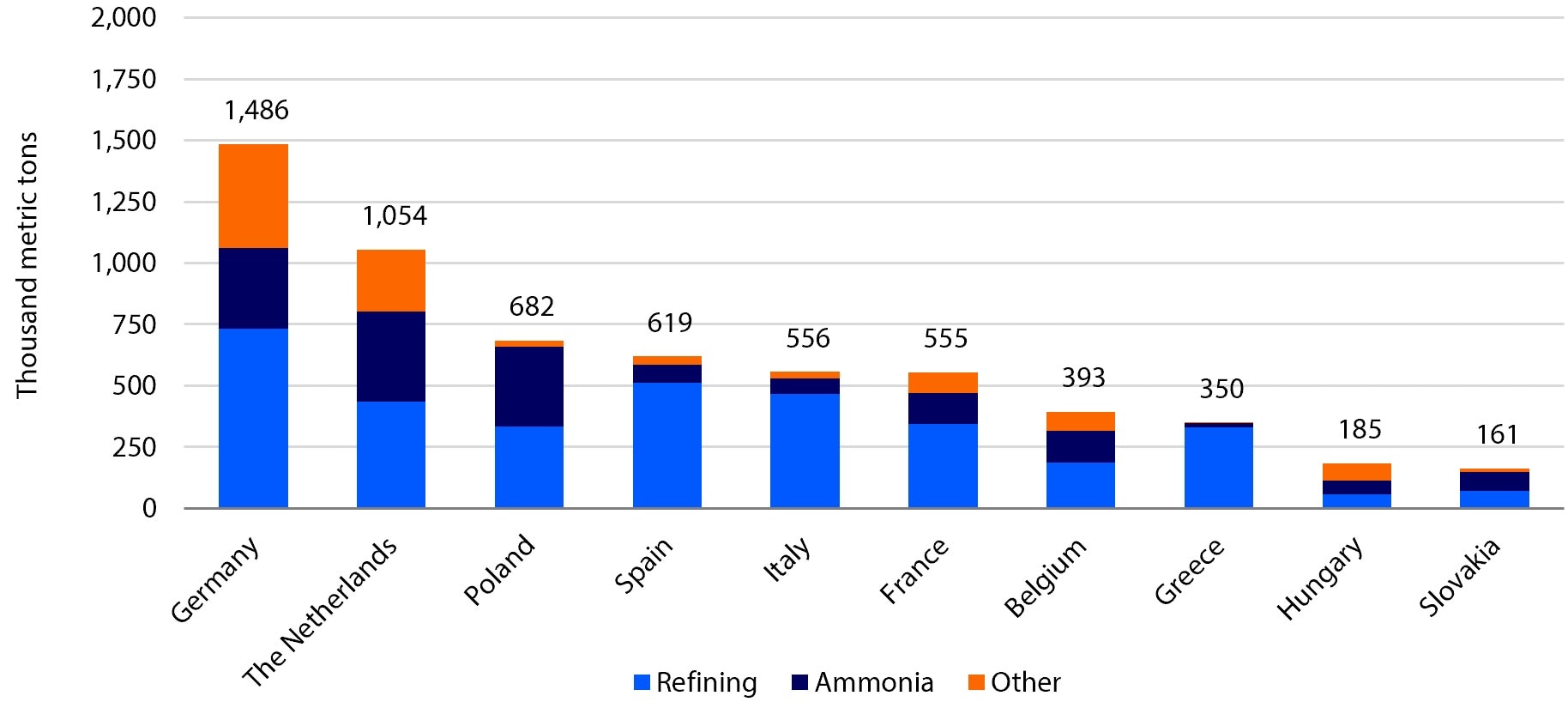
As shown in figure 1, Germany and the Netherlands are by far the largest users of gray hydrogen within the EU. The figure also highlights that the ten largest member state consumers predominantly use hydrogen in refining. This distinction is important because, as noted earlier, most refinery output is used to produce transport fuels.
Figure 1: The EU’s top 10 hydrogen consumers and their applications
While RED III sets common targets for member states, it provides them with a degree of flexibility in terms of implementation. The measures currently under development reflect this discretion and reveal notable differences in compliance frameworks and industry obligations across member states. Although the implementation deadline passed on May 21, 2025, the necessary regulatory frameworks have only recently been adopted or are nearing adoption, meaning the practical consequences are only now becoming clear.
The delay in implementation reflects concerns that many member states have over the challenging investment climate and the competitive position of their industry in the global and EU market. Many member states are proceeding cautiously in order to avoid imposing disproportionate costs on their energy-intensive industries. Among the EU’s largest industrial users of gray hydrogen, Germany and Spain have already enacted legislation to implement the directive, while the Dutch legislative process is nearing completion. Poland is lagging further behind, as it is awaiting the Dutch transposition and may adopt a similar approach.
The Netherlands, home to one of the EU’s largest ammonia industries, has opted for a hybrid implementation model. Under the proposed framework (in Dutch), a statutory RFNBO obligation of 4% applies at the production-facility level, while the remaining 38 percentage points are expected to be achieved through voluntary uptake supported by subsidy schemes. However, the effective mandatory volume is likely to be substantially lower than the headline 4% target suggests, as the legislation includes a range of exemptions that limit the scope of the obligation.
Other large consumers, like Germany and Spain, have adopted a different approach. Neither country has introduced an RFNBO obligation at the company level. This is permissible under RED III, as the directive places the legal responsibility for achieving the target on member states rather than on individual companies or subsectors. Consequently, both countries are relying primarily on subsidies and other support mechanisms to stimulate voluntary RFNBO uptake within industry and thereby contribute to meeting the RED III target.
Figure 2 shows the use of gray hydrogen in industry (excluding refineries) and whether the member states have transposed the 42% RFNBO target into a company-level obligation. The Dutch Ministry of Climate Policy and Green Growth, which is the source of the information, notes that the implementation approaches currently being considered by several member states remain insufficiently defined. While some member states intend to transfer all or part of the obligation to industrial hydrogen users, in many cases important details regarding enforcement and accompanying support measures have yet to be clarified.
Nevertheless, the comparison indicates that the Netherlands has adopted a unique implementation approach by converting the RED III 42% target into a legally binding obligation at the facility level. In contrast, other large industrial users such as Germany, Belgium, France, and Spain currently don’t impose obligations on individual companies or facilities, preferring to stimulate RFNBO deployment through voluntary uptake.
Figure 2: Gray hydrogen consumption (excluding refineries) and the (draft) transposition of the 42% RFNBO target
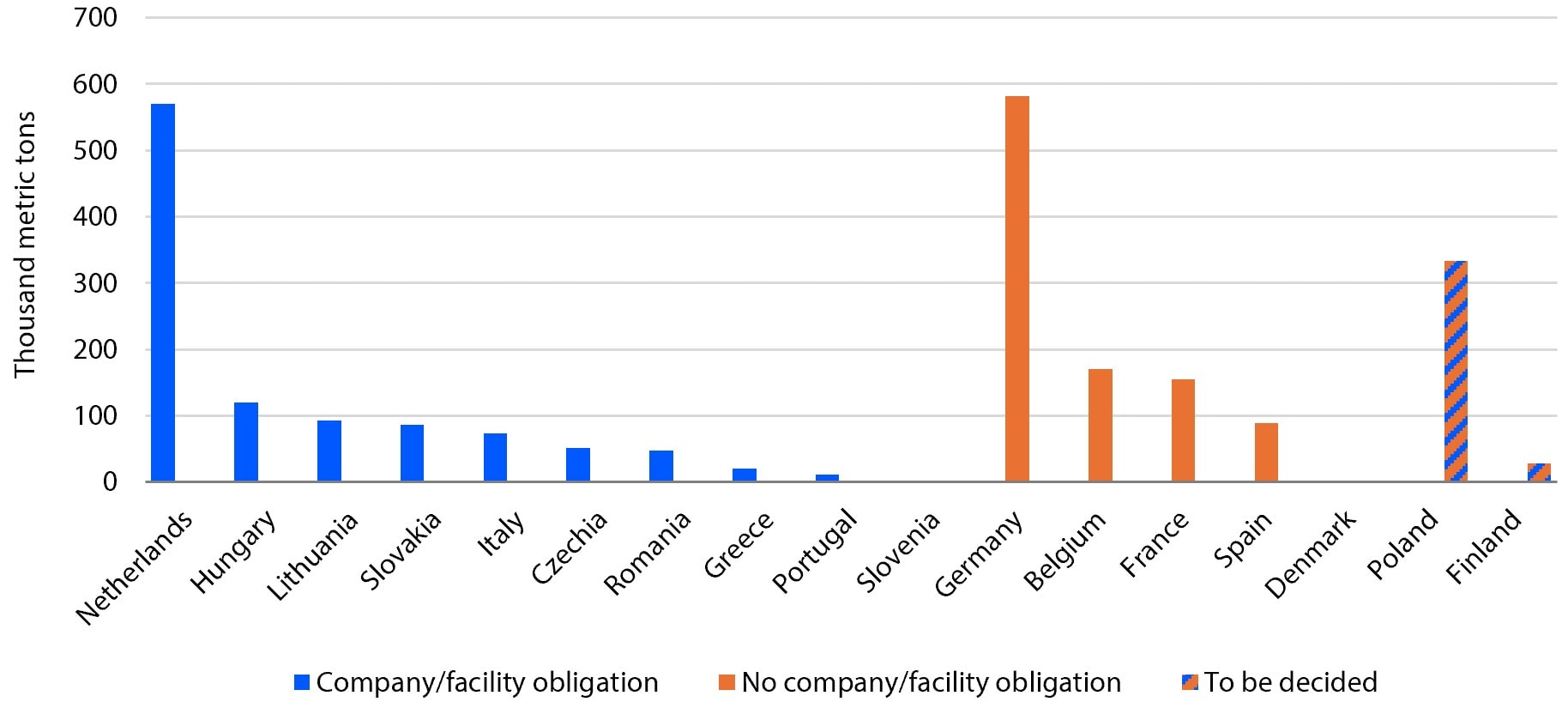
Source: European Hydrogen Observatory 2025, Dutch Ministry of Climate Policy and Green Growth memorandum 2026 (in Dutch), RaboResearch 2026
The refinery route offers a path of least resistance
While many member states with significant gray hydrogen consumption rely primarily on voluntary uptake by industry, they subject the transport sector to binding requirements, in line with the mandate to achieve a minimum RFNBO share of 1% of total energy consumption in transport by 2030.
At first sight, this appears counterintuitive. Industry contains many of the hardest-to-abate applications, for which RFNBOs may be the only viable decarbonization route. Yet the strongest compliance market for RFNBOs is emerging in transport, which has the option to go electric through battery electric vehicles. The explanation lies in the relative ease of implementation.
RFNBOs can be used directly in transport, either as pure renewable hydrogen in fuel-cell vehicles or after conversion into synthetic fuels such as e-kerosene, e-diesel, and e-gasoline. Both pathways face significant challenges. E-fuel production requires additional processing steps, including carbon capture, purification, and synthesis, which raise costs and reduce overall energy efficiency. Direct hydrogen use requires dedicated infrastructure for transport, storage, distribution, and refueling, as well as a sufficiently large fleet of compatible vehicles. In both cases, substantial investments are required across the value chain before significant demand can emerge.
Indirect use through the refinery route offers a much more pragmatic alternative. Under this approach, renewable hydrogen replaces gray hydrogen already used in refinery processes such as hydrocracking and desulfurization. RED III allows eligible renewable hydrogen used in fuel production to count toward the 1% RFNBO target if the fuels are used in the transport sector. This enables member states to meet transport obligations without waiting for large-scale deployment of fuel-cell vehicles, hydrogen refueling stations, or e-fuel production facilities.
One advantage is that the refinery route builds on existing assets and demand. Refineries already consume large volumes of hydrogen, possess hydrogen-handling expertise, and often have the necessary infrastructure in place. Renewable hydrogen can therefore replace existing fossil-based feedstock without requiring the development of entirely new end-use markets or extensive, new infrastructure. This helps overcome the chicken-and-egg problem that is a fundamental barrier in hydrogen market development: Demand will not materialize without the infrastructure to deliver hydrogen where it is needed, while infrastructure investment is difficult to justify without credible demand.
The refinery route also offers important financing advantages. Large integrated oil and gas companies typically have strong balance sheets, extensive project-development capabilities, and existing hydrogen consumption within the same corporate holding. This reduces many of the commercial risks that affect industrial hydrogen projects, such as securing long-term offtake agreements, managing counterparty risks, coordinating multiple stakeholders, and allocating project liabilities and risks. As a result, refinery-linked hydrogen projects have often progressed more quickly than projects targeting industrial users.
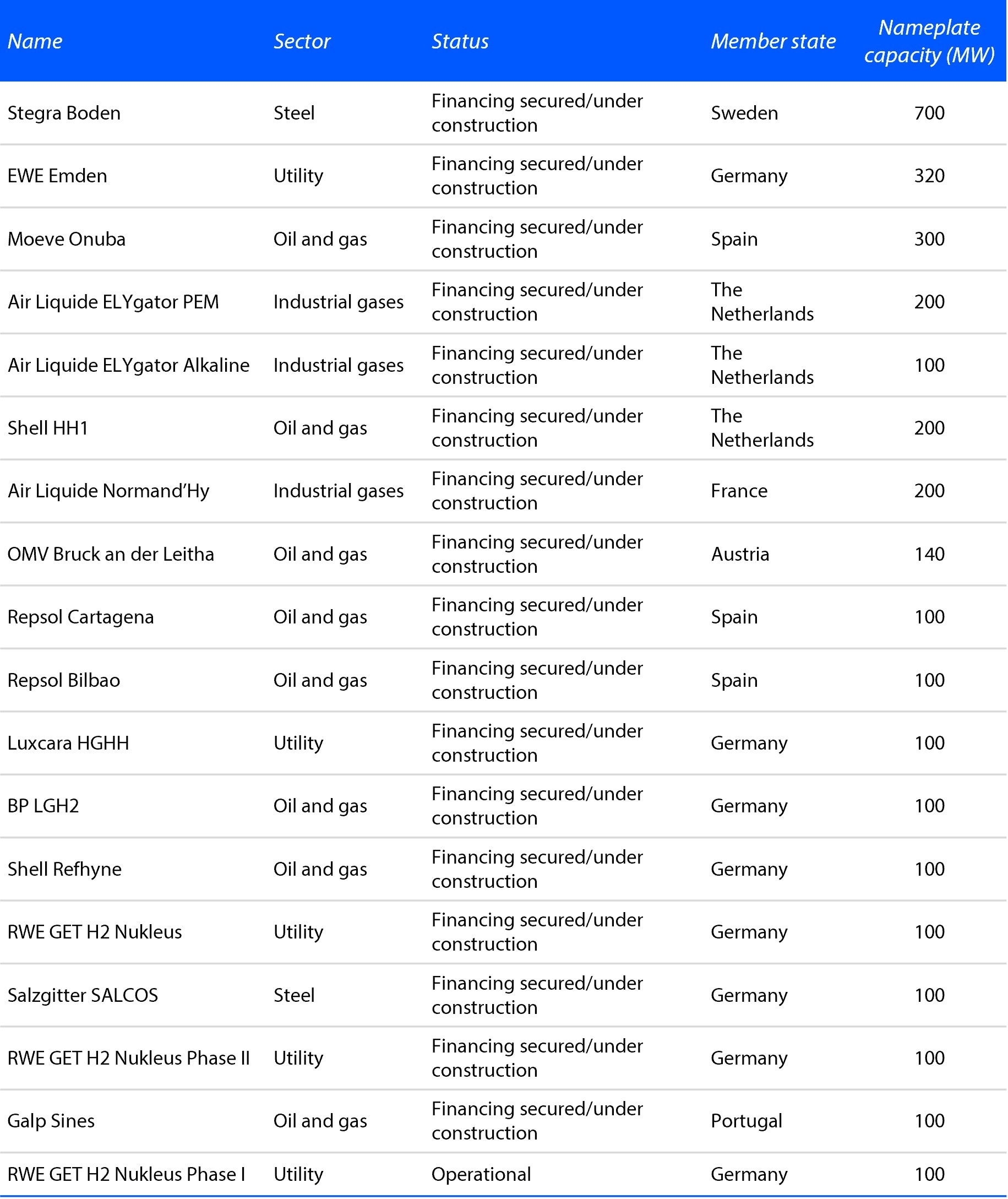
Table 1 lists all the projects in the EU that have secured financing or are already under construction. The selection contains projects with an electrolyzer capacity of 100MW or larger. Eight of the 18 projects are in the oil and gas sector and therefore likely to qualify under the refinery pathway. Five projects involve utilities, three are led by an industrial gas company, and two originate from the steel sector.
Table 1: RFNBO projects in the EU that are past final investment decision (>100MW), 2026
Cost recovery provides an additional policy rationale. By placing RFNBO obligations on fuel suppliers, the additional costs are allocated downstream, closer to the end market where a large customer base absorbs the cost through marginal increases in fuel prices. This is likely to have a smaller impact on competitiveness than imposing comparable costs directly on producers of internationally traded commodities, such as fertilizers and chemicals. These industries often face greater difficulties in passing costs on to customers and are more vulnerable to carbon leakage.
From a policymaker's perspective, the refinery route addresses several challenges simultaneously. It creates near-term demand for renewable hydrogen, concentrates compliance among a limited number of parties, leverages existing assets, reduces dependence on a fully developed hydrogen network, preserves industry competitiveness, and reduces the risk of carbon leakage. Its appeal lies less in its ability to fully decarbonize transport and more in its ability to kick-start the hydrogen market. In the longer term, though, this route will be less appealing as the rapid uptake of electric vehicles reduces demand for diesel and gasoline.
Member states take the refinery route to reach the industry target
Perhaps the most important reason why several member states favor the refinery route is that it can provide a shortcut toward compliance with the industrial RFNBO target.
In member states where refinery hydrogen consumption far exceeds that of industry, investments triggered by transport sector obligations could generate sufficient RFNBO volumes to cover a substantial share of industrial requirements. Once refineries start producing renewable hydrogen for their own operations, only a relatively small portion of these volumes would need to be diverted to industrial users to satisfy national industrial obligations.
As a result, the refinery route would become more than just the easiest pathway for early RFNBO deployment. It might also become the mechanism through which compliance with the industrial target can be achieved. The effect is particularly pronounced in member states with a favorable refinery-to-industry ratio, where refinery hydrogen demand is large relative to the hydrogen demand of industries covered by RED III. As shown in figure 1, this is the case for Spain, Italy, France, Greece, and to a lesser degree Belgium and Germany.
The flexibility mechanism in RED III reinforces the attractiveness of the refinery route. Under Article 22a, member states must ensure that RFNBOs account for 42% of the hydrogen used in industry for energy and non-energy purposes by 2030. However, Article 22b allows a 20% reduction of this target to 33.6% if two conditions are met:
- The member state is on track to meet its overall renewable energy contribution under Article 3.
- The share of hydrogen and hydrogen derivatives produced from fossil fuels that is consumed in that member state does not exceed 23% in 2030.
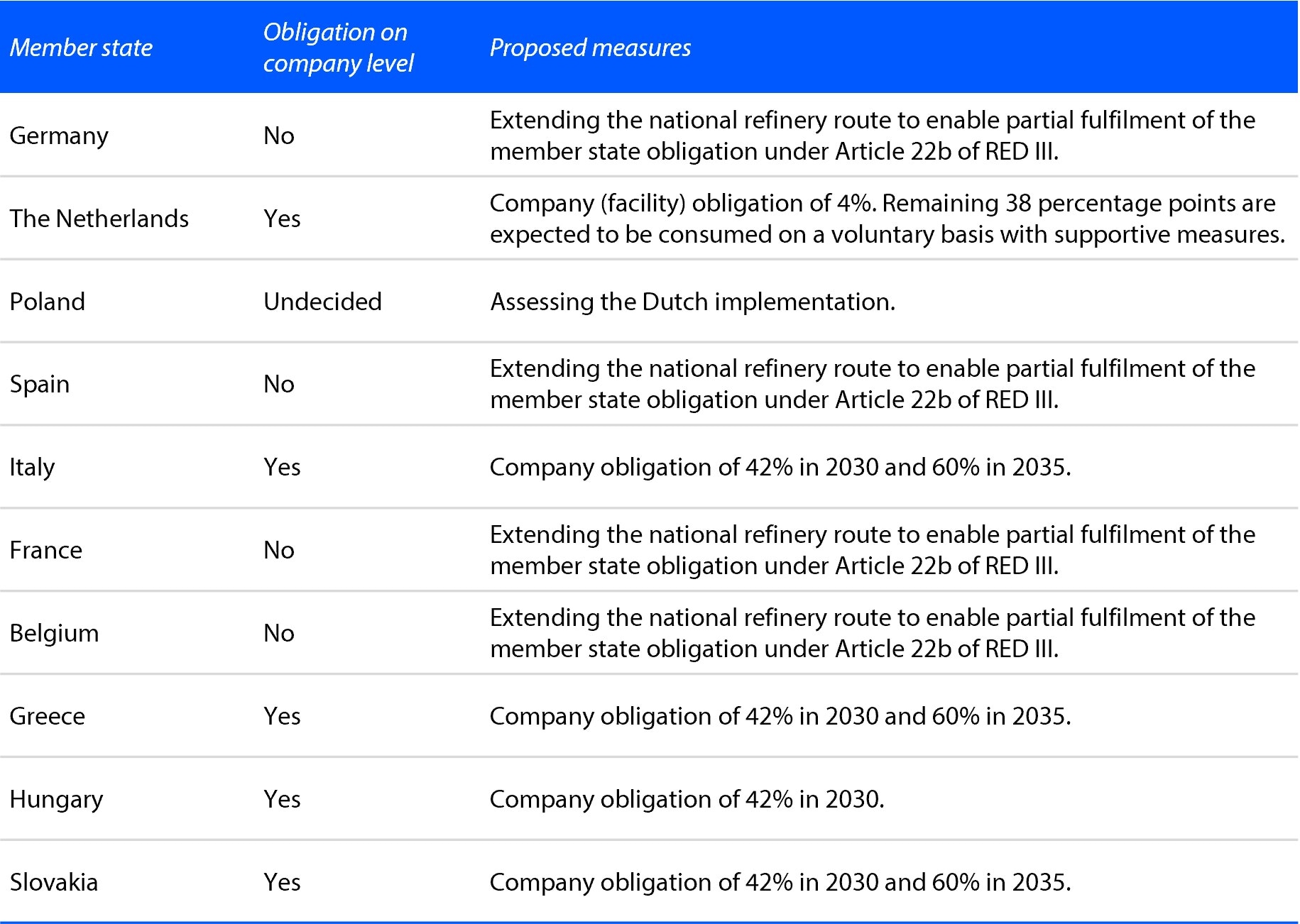
The refinery route can help member states with a favorable refinery-industry ratio to qualify for this flexibility. Because hydrogen demand in refineries significantly exceeds industrial hydrogen demand, only a relatively small share of refinery output would need to be allocated to industrial consumption. Such an allocation could have a disproportionate impact on the hydrogen balance underpinning Article 22b. This approach could be managed through an administrative process. While the details have yet to be fully defined, several member states are currently exploring it as a potential compliance pathway within the framework of RED III, as shown in table 2. In member states with a favorable refinery-to-industry ratio, this would present a shortcut to industry compliance by substantially reducing the volume of RFNBOs that must be supplied directly to industrial users.
Table 2: Extension of the refinery route by the EU’s top hydrogen consumers
The intention of RED III
Existing hydrogen demand, infrastructure, and financing capacity position the refining sector to contribute rapidly to transport and industrial RED III compliance targets. This supports early market deployment but also channels scarce and relatively high-cost RFNBO volumes into refining processes that ultimately produce predominantly fossil-based transport fuels, which will, in the longer term, face weakening demand as adoption of electric vehicles rises. As a result, refineries are emerging as a key source of early RFNBO demand across several member states, while uptake in hard-to-abate industries remains more limited for now. The question remains whether this was the intention of RED III.