Research
Chew it or Brew it - The Barley (R)evolution II: The Global Malting Industry in the Context of Brewery Mergers and Booming Craft Beers

The global malt industry will be in need of further consolidation given fierce competition, margin pressure, and consolidation in the brewing sector.
Summary
Maltsters will focus on:
Malting in key regions around the world
Global malt capacity exceeds 26m tonnes. This is relatively unchanged compared to 2010. Over the last years some newly-built plants have come online and existing plants were expanded or modernised, while other, mainly small, old, and/or inefficient plants were closed.
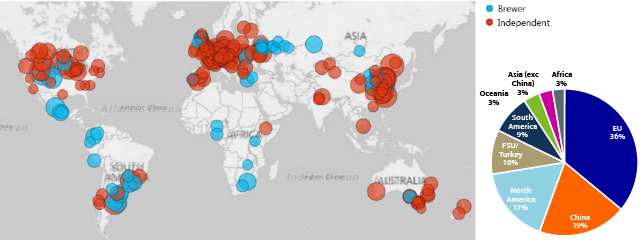
The EU accounts for more than one-third of the global malting capacity. Of total EU capacity, more than half is located in just three countries (Germany, the UK, and France). The majority of EU malting capacity is run by independent maltsters or integrated G&O companies—only a small part is made up of brewers with own malting facilities. And while the malting capacity in many EU countries is relatively consolidated, there is more room for consolidation both on a per country level and on a pan-European level. Especially when you consider that the top-three EU malting companies together hold 45% of the capacity, with 17 more companies holding another 50% of the capacity. With an industry structure somewhat more consolidated than that of the European milling industry, the strategic implications as outlined in ‘Consolidate, Specialise… or Both’ can, in parts, also be considered for the EU malting sector.
The Asian malting sector has grown to become the second largest in the world, holding 22% of capacity. This is especially due to the large malting capacity in China, which heavily relies on imports of malting barley. However, given that Chinese beer consumption is declining (-4.5% in 2016 and -3% in 2017), the malting industry is exporting some of its production to other Asian countries. About 20% of Asian capacity is integrated into brewing companies, while the remainder is run by independent companies and holds large potential for further consolidation. The South-East Asian malting industry does not meet the region’s demand, requiring imports of malt, especially from Australia. Malt imports into Asia are forecast to rise further to meet the projected future growth of beer demand in Asia.
North America has the third-largest malting capacity in the world and is already highly consolidated, with five companies holding 85% of the capacity. The US accounts for two-thirds of North American capacity. The fourth-largest market ( FSU/Turkey ) sees one-third of capacity owned by brewers and still holds room for consolidation, while the fifth-largest region (South America) sees brewers owning more than half of the capacity, with 80% of total capacity owned by just three companies. Oceania and Africa each account for 4% of global malting capacity and are highly consolidated—in Oceania, two G&O companies run more than 80% of the capacity and in Africa, two brewers account for about well above half of the industrial malting capacity.
The top malting companies
The global malting industry sees multiple players owning capacity across many countries. Since the mega merger in brewing between ABI and SAB, the combined company has become the largest global malting company. The top-ten of global maltsters also includes another global brewing company. The remainder of the top-ten malting companies is made up of six global or regional G&O companies and two large regional independent malting houses.
Malting margins
Although margins at malting houses are still better than those at wheat mills, Rabobank expects more consolidation in the global and regional malting industry. The speciality requirements of the growing craft brew sector can provide better malt margins for smaller batches of speciality malt.
Figure 1: Global malting capacity by region and by type (brewer or independent) in 2016
In the first article of this series we reviewed the developments in the global barley market.
This is an exclusive article
Log in or sign up to request access